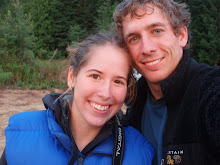
So for many this may be old news, but a recent story has made me concerned about people misusing auto-locking belay devices like the Petzl GriGri or the Edelrid Eddy. A couple months ago, Splitter Choss and the Climbing Narc fostered some discussion about the "proper" way to use a GriGri. If you've not seen this video, created by Petzl, and you belay with a GriGri, I suggest you watch it:
The video shows 2 ways of lead belaying with the GriGri without taking your break hand off the rope. It also shows a 3rd method, which I think the majority of people I observe at sport crags generally use, where the break hand is taken off the rope to let out slack when the leader needs to make a clip. I think this was the way I was taught to lead belay with a GriGri and I have passed plenty of lead belay tests without being reprimanded, so my impression is that this is a generally accepted method of using the device.
The problem is that it isn't really an acceptable way to use the device. It fosters bad habits - I've seen plenty of belayers not returning their break hand to the rope, even when not letting out slack. It encourages the idea that it's ok not to hold on to the break rope, which is a bad habit to pick up if you also belay with a traditional (non-auto-locking) belay device or in the unlikely (but still possible) situation that the leader falls and the auto-locking belay device does not engage.
The reason I bring this up is that I recently heard of a bad climbing accident that occurred due to similar misuse of an Edelrid Eddy, which is an auto-locking belay device similar to the GriGri (it must be "pinched" so that the cam will not engage and slack can be let out). A climber was leading a sport route in Maple Canyon when he took a fall. The belayer did not have his break hand on the rope at the time. The Eddy did not catch on the relatively new 9.2mm rope and the belayer did not manually arrest the fall. The climber therefore took a 50-foot fall to the ground and suffered serious injuries, although luckily a full recovery is expected.
The moral of the story is clear: although auto-locking belay devices are great and make the life of a belayer much easier, they cannot be trusted absolutely to catch any fall. They do not grant the belayer the freedom to let go of the break rope.
When I encountered the discussion on the Climbing Narc's post, I was initially unsure that I even could change my method of belaying (I used to use the "bad" method, #3). I have quite small hands and I like to wear belay gloves, so I was unsure that the rope could still feed easily through my break hand while I was simultaneously pinching the belay device. However, Luke and I have both adopted method #2, which in fact works quite well, even with small hands and belay gloves. It requires a little more rope management so the rope will feed easily, but I think the increased safety is well worth this extra effort. I would never want to drop a leader because I was being a lazy belayer. I also think it's important, since I use a Reverso (just got the new one!!!) just as often as a GriGri, to foster good belay habits (i.e. not taking the break hand off the rope) rather than bad ones.
So to make a long story short, I wrote this post and brought up the video again because I think the biggest problem with auto-locking belay devices like the GriGri or the Eddy is a lack of knowledge. People just don't know that these devices are not a substitute for belay skills and safety. So now you know. Please think about the friends that you're belaying and make sure you're being a safe belayer.
Best,
Lizzy
Showing posts with label sport. Show all posts
Showing posts with label sport. Show all posts
Friday, July 18, 2008


Wednesday, July 16, 2008
East Coast Crimping, a day in Rumney, NH
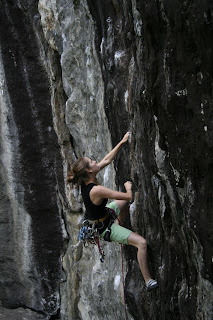 Rumney has to be one of my favorite sport climbing areas in the country. Beautiful rock tucked away in the rolling hills of New England. The various crags offer a variety of angles on interesting rock of many different colors. Climbing mid week we were able escape the Rumney scene that has developed in recent years.
  It seems fitting that I returned to Rumney en route to my friend Adam's wedding for it was with him that I first visited Rumney. On my first and only other trip to Rumney Adam and I headed out for the 7+ hour drive from Bucknell on a Wednesday night. Some how we were both able to play hooky for a few days and wanted to get a bit of climbing in before the snow set in for the winter. We drove north through pouring rain too excited and stubborn to let the weather effect our mood. Despite almost two and half days of rain on a 4 day trip we had a blast, sent hard and vowed to come back to our unset projects.
 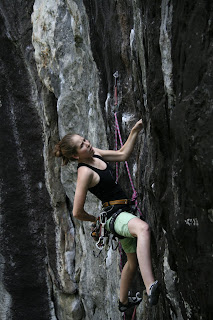 This trip was to be my glorious return to Rumney and we sure had a blast. Lizzy and Rebecca had never been to Rumney and I was excited to show them the many fun climbs Adam and I had played on over a year previous. Our day started at Waimea and we had the cliff all to our self. The sun still hiding behind the rocks and we enjoyed to cool shade. The name sake climb and the easiest on the wall is Waimea 10d. This climb follows black water streaks up a vertical wall to a tricky crux on runnels and feet pointing the wrong direction.
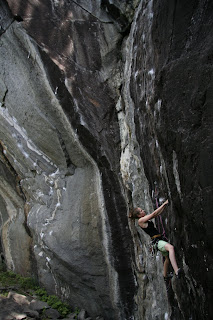
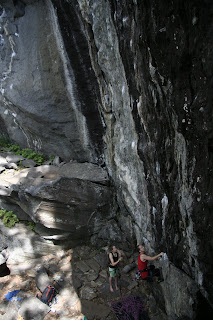 Waimea sits next to some of the hardest routes at Rumney and while moderate in grade can be quite pumpy. In the second photo you can see Livin' Astro 14c, China Beach 14b, and Jaws II 15a. While not a great warm-up for those climbing 5.11 it was our only option. Lizzy was able to work through a trick top crux, ignoring my incorrect beta, and set despite a dizzying flash pump. Rebecca quickly worked her way up to the crux and could not figure out the sequence and took a nice clean lead fall. Working on her mental game she got back on the route and finished it up.
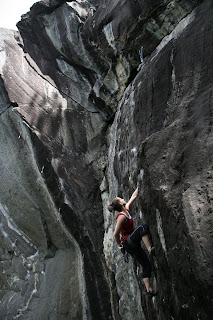 My main goal and unsent project from my last trip was Techno Surfing 12b. On my final burn last trip I had fallen post crux with only one draw between me and the anchors. While the technical crux is much lower there is one hard move right before the last bolt and then you are quite pumped making the final moves to the anchor. On my first try I wimped out at the crux and took. I was a bit out of my mental space and was not excited to see the same fixed draws on the route as the last time i had been on it almost a year and half earlier. I hung my way up the route and figured out all of the beta and lowered to rest.
  Lizzy was busy taking a nap recovering from our late night and day of travel so Rebecca went to work on Flyin’ Hawaiian (photo below). I had history with this line and was excited to see how it would feel. The start was quite bouldery with difficult moves over a rocky landing so we stick clipped the first two bolts. Rebecca worked through a good intro sequence but was falling off a strenuous left hand pinch. Lizzy woke up rested and excited to give it a go. She was able to refine the start beta and match the left pinch but could not keep body tension to get her feet up and make the next move. After many tries the ladies opted for some rest and I got back on Techno Surfing.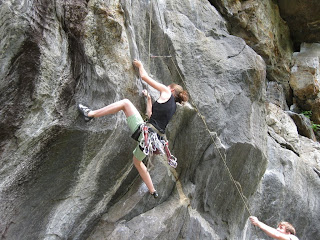
The first hard moves went well (photo below) and in no time I was resting below the crux bulge. I started off into the crux sequence and then the rope got stuck on my harness buckle while I was trying to clip. I dangled from the two handed jug and waved my legs around. Helpless to change it I heel hooked above my head and clipped. Energy sapped I forced my self to continue and made it through to the next ledge rest. Commitment and fast movement would be key for the last hard move. I crimped hard with my left hand committed and a few moves later found my self clipping the anchors. 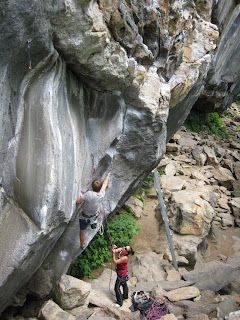
Next I lead Flyin’ Hawaiian which was just as hard as I remembered and Lizzy and Rebecca top roped it. They both found it thuggish and fell at the tricky moves that gained the upper dihedral. Hoping to get in some more enjoyable for the girls we headed over to Orange Crush. This wall is steep at the top but offers some nice vertical lines in the middle of the cliff. I had hoped to link the full Black Mamba which Adam and I had done in two pitches but the top section was seeping. Technical moves on beautiful black rock make this route one of the best 5.11's at Rumney. The vertical small hold climbing allowed the girls to use their balance as they danced up this route. Rebecca enjoyed it so much she did it twice. Both Lizzy and Rebecca vowed to lead it when they return. I had time to finish up one more project and got on Captain Hook. It was a bit warmer and more humid at Orange Crush which was less than ideal for the small crimps on this route. After hanging the draws and remembering the beta I was able to send on my second try. The first crux deadpoint was much harder than I remembered but I was in control and only mildly pumped at the top crux. Also I found a left kneebar that allowed me to easily clip the anchors.
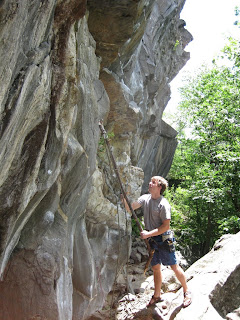
We were all tired and it was getting late so we got pizza in town. A nice treat after a long day of hard climbing! It was great to get back to Rumney and I cant wait to return!
- Luke
Wednesday, June 25, 2008
Alpine Retreat - Clipping bolts at Mt Charleston
I needed to get out, I just wanted to leave, go somewhere, change the flow of things. But I am not a spontaneous person, I like to make plans and follow them. This balance always strikes me and I don’t know what to do, which furthers my problem. I like doing things, keeping busy and chugging forward. I enjoy keeping my schedule full so that when I do have some free time I enjoy it and truly relax.
Friday came around and plans for the weekend were far from settled. Lizzy had been spending time in her Air Conditioned room away from 100+ degree heat while I had been plugging along at work. Even climbing in the shade we would be met with 90+ degree weather and would likely melt before sending anything. Our drastic times called for drastic measures and I came up with a plethora of plans. This can easily become a problem as Lizzy and I try to sort between the nuisances of each possible climbing location. The common theme was high elevation and camping. We would need to spend the whole weekend out of LA and somewhere cool. Fearing the hoards and with a slight dislike of the granite of Big Bear we decided on Mt Charleston.
Gas these days I at a premium and adds new words to the American vocabulary like “Stay-cation” but honestly who the hell wants to do that. I want to explore the world, I want to journey to new places and I want to get out of here. NOW! Adjusting to meet the best temperatures I worked on Saturday and we left for Vegas on Saturday night. The five and half hour drive was traffic free but required constant AC as we made our way into the Vegas heat. After passing by the strip we headed north on the 95 out into the unknown. A small turn off and a sign for Mt Charleston signaled our rise to elevation and a retreat into cooler temperatures. Reservations were suggested but required three days of advanced notice for the Kyle Canyon Campgrounds.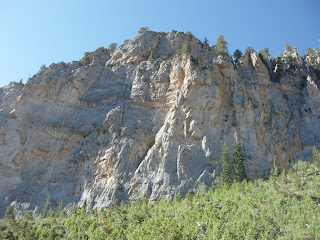 With the two main campgrounds full we headed to the Mary Jane Area. This multiple abuse site, once home to a historical ski tow, was a gravel parking lot near the Mary Jane trailhead. All of the “spots” on the periphery were taken so we parked near the center and set up our tent. Bugs instantly flocked to our headlamps but the temperatures had dropped and we were quickly asleep. With the sun rising around 5am, I was excited and anxious to go climbing. Getting up to go to the bathroom at first light I had seen towering limestone walls and had a hard time going back to sleep.
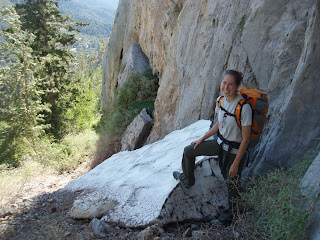 Unable to wait any longer, I roused Lizzy and we packed up and had breakfast by 6:30. After a bit of confused driving, undoubtedly caused by our mere 6 hours of sleep, we wound up hiking up the trail next to the ski tow. Our trail led us to the base of the north facing Imagination Wall, 500 feet of glorious limestone. At the base of our warm-up the rock was intimidating and devoid of familiar features. Sharp crimps and runnels dotted the face and without chalk the sequence was far from obvious. The base of the Imagination wall is slabby and the rock offers excellent friction, the climbing requires subtle body movement and a keen eye for “holds”. After warming up I jumped on a 10d that might make a good lead for Lizzy. This however was far from the truth. After breaking a foothold, stick clipping the second bolt and shakely climbing to the 3rd bolt at 40 feet I decided to bail. The next bolt was 15 feet higher and I was not yet confident on this type of climbing. I had fallen prey to the Exacto Blade (the route's name) and did not have the mental energy to complete this route that was undoubtedly bolted on lead.

Confidence shattered, we moved down the cliff to try a few of the other “moderate routes”. After bailing on three different variations of this 11a, I found passage on one of the harder neighboring routes. While not a clean lead I was finally able to make it to the top. The ending of this 11b had what I wanted, wonderful pinches and crimps, tricky footwork and tension moves, most importantly real HOLDS! Finally getting to climb after my flailathon Lizzy mad quick work of this balancey climb.

After one more fun 11b, evidently the good grade to climb at this wall, and a bit of heinous top roping we departed for Robbers Roost. The weather had been ideal and the wall was completely in the shade causing Lizzy to don all of our jackets. Even though we were a bit tired I convinced Lizzy that more climbing was in order and with the promise of a five minute approach we were on our way. The scene at Robbers Roost was the opposite of the solitude of the Imagination Wall. There were tourists and climbers sandwiched in the cave like venue. The walls were covered with fixed draws and chalk and most of the climbs were overhanging.
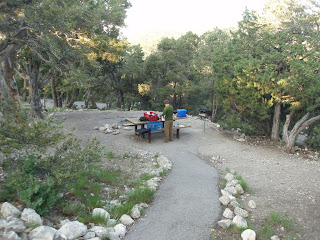 With some friendly advice from one of the locals we warmed up again and we did a few more climbs. While these routes had tricky cruxes they had nice holds and jugs and one even had a sit down rest. Excited by a more athletic style we decided to return the next day so Lizzy and I could work on some harder routes. Hilltop, the third campground in the area, was close by and we still needed a place to sleep. With showers and a toilet this was a big step up from the Mary Jane Area. Hiltop hade excellent views and is about 1000 feet higher than Kyle and Fletcher campgrounds. Since it was Sunday night we had no problem finding an excellent site in the shade. If you are ever there I suggest site number #21 despite not having a view it was fairly wind protected and had evening shade.
  Monday we returned to the Roost and climb the namesake route (photo below). This climb, another lead bolted scare fest, was technical with bad falls on sharp rock. The movement and hold variety was classic limestone and excellent if you could move past a fear of falling. This climb had deep runnels and great pinches. I found the crux to be a tricky bit of stemming after a good rest about midway through the route. While this did not function as a good mental warm-up it got the blood moving and allowed me to focus on harder routes. First up was an onsight attempt on a route that had been occupied the previous day. After a bunch of tricky climbing I gave up a foot below a hidden jug. Lack of commitment and a bit of memory loss left me hanging but with no regrets as I made my way to the top I encountered a much more beta intensive crux that would have blown the onsight. Next go, much more relaxed, I sent Bubbleicous.

Lizzy was in the projecting mood and jumped on Los Banditos, an 11c that she had done clean first try on TR the day before. This would be her first of the grade and over the day she made excellent progress. Between my attempts on different routes she gave this route three good burns and on her final try fell one hold below jug at the end of the crux. She made good progress with each try and feeling fresh on our next visit I think this climb is within her reach.

I attempted some of the classic harder routes in the area but was stopped by tricky beta, fatigue and altitude. Leaving tired we made the journey back to San Diego happily avoiding Vegas rush hour. Despite a lack of hard sends I feel the weekend was quite satisfying and have a new respect for the complexity of limestone. I am excited to go back, since according to the locals you can climb there all summer.
- Luke
Friday came around and plans for the weekend were far from settled. Lizzy had been spending time in her Air Conditioned room away from 100+ degree heat while I had been plugging along at work. Even climbing in the shade we would be met with 90+ degree weather and would likely melt before sending anything. Our drastic times called for drastic measures and I came up with a plethora of plans. This can easily become a problem as Lizzy and I try to sort between the nuisances of each possible climbing location. The common theme was high elevation and camping. We would need to spend the whole weekend out of LA and somewhere cool. Fearing the hoards and with a slight dislike of the granite of Big Bear we decided on Mt Charleston.
Gas these days I at a premium and adds new words to the American vocabulary like “Stay-cation” but honestly who the hell wants to do that. I want to explore the world, I want to journey to new places and I want to get out of here. NOW! Adjusting to meet the best temperatures I worked on Saturday and we left for Vegas on Saturday night. The five and half hour drive was traffic free but required constant AC as we made our way into the Vegas heat. After passing by the strip we headed north on the 95 out into the unknown. A small turn off and a sign for Mt Charleston signaled our rise to elevation and a retreat into cooler temperatures. Reservations were suggested but required three days of advanced notice for the Kyle Canyon Campgrounds.
With the two main campgrounds full we headed to the Mary Jane Area. This multiple abuse site, once home to a historical ski tow, was a gravel parking lot near the Mary Jane trailhead. All of the “spots” on the periphery were taken so we parked near the center and set up our tent. Bugs instantly flocked to our headlamps but the temperatures had dropped and we were quickly asleep. With the sun rising around 5am, I was excited and anxious to go climbing. Getting up to go to the bathroom at first light I had seen towering limestone walls and had a hard time going back to sleep.Unable to wait any longer, I roused Lizzy and we packed up and had breakfast by 6:30. After a bit of confused driving, undoubtedly caused by our mere 6 hours of sleep, we wound up hiking up the trail next to the ski tow. Our trail led us to the base of the north facing Imagination Wall, 500 feet of glorious limestone. At the base of our warm-up the rock was intimidating and devoid of familiar features. Sharp crimps and runnels dotted the face and without chalk the sequence was far from obvious. The base of the Imagination wall is slabby and the rock offers excellent friction, the climbing requires subtle body movement and a keen eye for “holds”. After warming up I jumped on a 10d that might make a good lead for Lizzy. This however was far from the truth. After breaking a foothold, stick clipping the second bolt and shakely climbing to the 3rd bolt at 40 feet I decided to bail. The next bolt was 15 feet higher and I was not yet confident on this type of climbing. I had fallen prey to the Exacto Blade (the route's name) and did not have the mental energy to complete this route that was undoubtedly bolted on lead. Confidence shattered, we moved down the cliff to try a few of the other “moderate routes”. After bailing on three different variations of this 11a, I found passage on one of the harder neighboring routes. While not a clean lead I was finally able to make it to the top. The ending of this 11b had what I wanted, wonderful pinches and crimps, tricky footwork and tension moves, most importantly real HOLDS! Finally getting to climb after my flailathon Lizzy mad quick work of this balancey climb.
After one more fun 11b, evidently the good grade to climb at this wall, and a bit of heinous top roping we departed for Robbers Roost. The weather had been ideal and the wall was completely in the shade causing Lizzy to don all of our jackets. Even though we were a bit tired I convinced Lizzy that more climbing was in order and with the promise of a five minute approach we were on our way. The scene at Robbers Roost was the opposite of the solitude of the Imagination Wall. There were tourists and climbers sandwiched in the cave like venue. The walls were covered with fixed draws and chalk and most of the climbs were overhanging.
With some friendly advice from one of the locals we warmed up again and we did a few more climbs. While these routes had tricky cruxes they had nice holds and jugs and one even had a sit down rest. Excited by a more athletic style we decided to return the next day so Lizzy and I could work on some harder routes. Hilltop, the third campground in the area, was close by and we still needed a place to sleep. With showers and a toilet this was a big step up from the Mary Jane Area. Hiltop hade excellent views and is about 1000 feet higher than Kyle and Fletcher campgrounds. Since it was Sunday night we had no problem finding an excellent site in the shade. If you are ever there I suggest site number #21 despite not having a view it was fairly wind protected and had evening shade. Monday we returned to the Roost and climb the namesake route (photo below). This climb, another lead bolted scare fest, was technical with bad falls on sharp rock. The movement and hold variety was classic limestone and excellent if you could move past a fear of falling. This climb had deep runnels and great pinches. I found the crux to be a tricky bit of stemming after a good rest about midway through the route. While this did not function as a good mental warm-up it got the blood moving and allowed me to focus on harder routes. First up was an onsight attempt on a route that had been occupied the previous day. After a bunch of tricky climbing I gave up a foot below a hidden jug. Lack of commitment and a bit of memory loss left me hanging but with no regrets as I made my way to the top I encountered a much more beta intensive crux that would have blown the onsight. Next go, much more relaxed, I sent Bubbleicous. Lizzy was in the projecting mood and jumped on Los Banditos, an 11c that she had done clean first try on TR the day before. This would be her first of the grade and over the day she made excellent progress. Between my attempts on different routes she gave this route three good burns and on her final try fell one hold below jug at the end of the crux. She made good progress with each try and feeling fresh on our next visit I think this climb is within her reach.
I attempted some of the classic harder routes in the area but was stopped by tricky beta, fatigue and altitude. Leaving tired we made the journey back to San Diego happily avoiding Vegas rush hour. Despite a lack of hard sends I feel the weekend was quite satisfying and have a new respect for the complexity of limestone. I am excited to go back, since according to the locals you can climb there all summer.
- Luke
Tuesday, June 17, 2008
Climbing at Horse Flats and the Riverside Quarry
Summer is here and we have been banished to the shade and the mountains. The sun quickly heats the rock and friction becomes non-existent. We spent Friday night camped out at REI to attend one of their Scratch and Dent sales. Despite arriving at 10pm there were 10 people ahead of us in line. Some arrived as early as 4pm. We managed to get a bit of sleep despite the random urban setting of Arcadia. The sale was fun but not very eventful. One of my friends, Hartley, from Santa Barbara was supposed to come down for the sale and an afternoon of bouldering at Stoney Point. A case of food poisoning kept him grounded in SB.
With my schedule free I decided to tag along with Lizzy and Julie who had been invited to go on a Mad Rock catalog shoot. One of the local climbers recruited these girls and was planning on a day of bouldering to get some shoe photos.
We headed up to Horse Flats which is in the Angeles forest in the hills just north of Pasadena. Windy roads and pretty scenery brought us up a few thousand feet to a granite boulder field. My last experience on granite had been less than fun and I was a bit skeptical of what this area had to offer. Fortunately the rock was highly featured metamorphosed granite. It has lots of crystals and despite being a bit flakey offered fun problems.
Josh Wagner, from the Arcadia Rock Gym, and I bouldered while the ladies played with new shoes and took photos. Josh gave me a tour of a few classics and showed me some problems that were not in the guidebook. After taking a look at a super-project we tackled a possibly unclimbed block. Crystals were still falling off at the base and showed no evidence of previous ascents. There was a steep holdless fin and that formed the right side of a dihedral. The angle and lack of holds prevented us from the obvious stemming solution.
Starting from a good right hand you could gain a small sharp two finger crystal with your left hand. Then you had to make a full span to a decent right hand pinch. The remaining moves to the top were less obvious. After reaching the pinch I could make not make any further progress. I shifted my focus to the arête on the left side of the dihedral. A span start and some tenuous smears on the arête allowed you to gain the same crystal as a gaston with the right hand. Using this to bump my left hand up the arête I was able to stand on a high crystal, bump to another sharp gaston and finally bump my left hand to a good hold around the top of the arête. Possibly a FA but most likely done by Wills Young back in the day. I needed a break after the send and went and check on Lizzy who had flashed a crimpy problem and was spotting while the other two girls tried it. Upon my return Josh had solved the right variation and was sitting on top of the boulder. A possible FA each within an hour, pretty good work :-D
My elbow, which has been hurting, needed a rest so I followed the girls around helping light the problems by holding a bounce card. The two bounce cards did an amazing job of adding directional light to the photos. I was super impressed and hopefully can get some in the next six months. I only saw a few of the photos but they looked pretty good and can be found on facebook! When we got back to Pasadena we crashed early with a serious lack of sleep and full day in the sun.
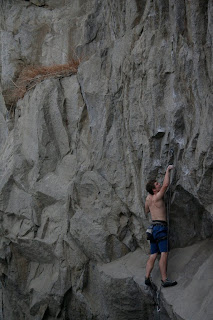
Sunday we got up early for some shady sport climbing at the Riverside Quarry. We had not been to the quarry in six months and it was fun to clip lots of bolts. Stein, my climbing partner from San Diego, met us with one of his friends for our early session. Stein is quite the quarry master and was excited to clip some bolts outside for a change. We have spent many more hours training on plastic than actually climbing routes. Stein helped me to get in a hard climbing mindset and put draws on a bunch of climbs for me.
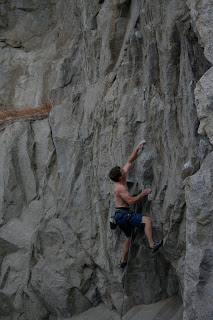
After Lizzy and I warmed up we got on Salutations a nice 11c that Stein and George had just finished. The quarry is filled with boulder problems separated by good holds and hand free rests. This visit I embraced this style and had much more success. I flashed/onsighted (I saw a bit of beta) the first route and set up a TR for Lizzy. She cruised the starting moves but had to spend a bit of time figuring out the reachy crux. After finding a powerful sequence she pulled through the small holds and gained a good jug. After some slopey holds she finished off the route. The crux was definitely challenging. Focusing on the jug allowed me to commit to the 3 or 4 hard moves on the small crimps.
With my schedule free I decided to tag along with Lizzy and Julie who had been invited to go on a Mad Rock catalog shoot. One of the local climbers recruited these girls and was planning on a day of bouldering to get some shoe photos.
We headed up to Horse Flats which is in the Angeles forest in the hills just north of Pasadena. Windy roads and pretty scenery brought us up a few thousand feet to a granite boulder field. My last experience on granite had been less than fun and I was a bit skeptical of what this area had to offer. Fortunately the rock was highly featured metamorphosed granite. It has lots of crystals and despite being a bit flakey offered fun problems.
Josh Wagner, from the Arcadia Rock Gym, and I bouldered while the ladies played with new shoes and took photos. Josh gave me a tour of a few classics and showed me some problems that were not in the guidebook. After taking a look at a super-project we tackled a possibly unclimbed block. Crystals were still falling off at the base and showed no evidence of previous ascents. There was a steep holdless fin and that formed the right side of a dihedral. The angle and lack of holds prevented us from the obvious stemming solution.
Starting from a good right hand you could gain a small sharp two finger crystal with your left hand. Then you had to make a full span to a decent right hand pinch. The remaining moves to the top were less obvious. After reaching the pinch I could make not make any further progress. I shifted my focus to the arête on the left side of the dihedral. A span start and some tenuous smears on the arête allowed you to gain the same crystal as a gaston with the right hand. Using this to bump my left hand up the arête I was able to stand on a high crystal, bump to another sharp gaston and finally bump my left hand to a good hold around the top of the arête. Possibly a FA but most likely done by Wills Young back in the day. I needed a break after the send and went and check on Lizzy who had flashed a crimpy problem and was spotting while the other two girls tried it. Upon my return Josh had solved the right variation and was sitting on top of the boulder. A possible FA each within an hour, pretty good work :-D
My elbow, which has been hurting, needed a rest so I followed the girls around helping light the problems by holding a bounce card. The two bounce cards did an amazing job of adding directional light to the photos. I was super impressed and hopefully can get some in the next six months. I only saw a few of the photos but they looked pretty good and can be found on facebook! When we got back to Pasadena we crashed early with a serious lack of sleep and full day in the sun.
Sunday we got up early for some shady sport climbing at the Riverside Quarry. We had not been to the quarry in six months and it was fun to clip lots of bolts. Stein, my climbing partner from San Diego, met us with one of his friends for our early session. Stein is quite the quarry master and was excited to clip some bolts outside for a change. We have spent many more hours training on plastic than actually climbing routes. Stein helped me to get in a hard climbing mindset and put draws on a bunch of climbs for me.
After Lizzy and I warmed up we got on Salutations a nice 11c that Stein and George had just finished. The quarry is filled with boulder problems separated by good holds and hand free rests. This visit I embraced this style and had much more success. I flashed/onsighted (I saw a bit of beta) the first route and set up a TR for Lizzy. She cruised the starting moves but had to spend a bit of time figuring out the reachy crux. After finding a powerful sequence she pulled through the small holds and gained a good jug. After some slopey holds she finished off the route. The crux was definitely challenging. Focusing on the jug allowed me to commit to the 3 or 4 hard moves on the small crimps.
 Stein had finished an impressive onsight of the neighboring Balrog 12b and I got to watch George as the top roped it. I got a sense of where some of the good holds were and what sections would prove difficult. There was an obvious high crux that I would need to save my energy for if I was to send. The first two bolts were simple with a fun mantle onto the slab seen in the first photo. The slopey holds in the second photo blew my confidence and I was insecure and overgripping. I made the third clip from a bad hold and was happy when I got the next hold which happened to be a jug. The next few bolts were easy until a tricky clip. Following this clip were more slopey holds and bad feet. I figured out a heel hook sequence that worked well but I was getting tired. I now was one bolt below the crux and was quite pumped and being unsure of the sequence I gave up. I figured out a way to set up for the clip below the crux but it was quite powerful and zapped my energy for the crux. I hung again and tried to figure out a good way to do the crux. A few more takes and I was through the crux and at the anchors.
 Stein had enjoyed the route so much he ran another lap to get some mileage. I watched closely on the parts I had struggled on and figured out a better way to setup for the crux clip. After some rest I went up again making sure to stay relaxed and to flow through the moves. The crux was a tricky gaston cross over sequence right after a powerful clip. I got up to the clip and was able to make it but the next sequence Stein had used proved a bit too reachy and I could not get the same heel hook he had. Hands out of sequence I committed to a higher heal hook that I was able to perch on. This enabled me to rest a little and switch my hands to prepare for the crux. I got my high left foot and right gaston but it felt much worse than my last go. I grunted and fired left hand across to the next good hold. I stuck it and quickly move my feet up to the good holds on the right. A few more moves gave way to an ok rest. A few shakes and I set up for the final tricky move to a crack below the anchor. I trusted my smear and shot my right hand to the undercling crack. Two more adjustments and I was clipping the anchor! I was tired and my climbing was still a bit sloppy but I had committed at the crux and this was important mental progress!
Photos thanks to Lizzy!
- Luke
Wednesday, May 28, 2008
Wacky Weather Weekends
The last two weekends we spent time exploring some areas that we had not been to. Our efforts were motivated by the crazy weather systems that have been moving through California and the rest of the country. One week of crazy hot weather was followed by the coldest temps we have had in two months. Traveling between the mountains and the desert we were able to get in a bit of climbing both last weekend and this weekend.
Last weekend were above 90 degrees in the Santa Monica Mountains so drove up to Big Bear Lake, home of the Holcomb Valley Pinnacles. Big Bear, sitting above 7000 feet is also home to a bunch of ski resorts that are very popular among the LA hoards.
With a late start and a long drive we were barely climbing by noon. Luckily the cliff had chosen was going into the shade and was fairly uncrowned. We enjoyed closely bolted sport climbs on well featured granite. The rock had fun holds but the quality was less than desirable. On one of my projects for the day I managed to make the start a bit harder when the hold under my foot flaked off the wall. The good right hand crimp used for the crux start sequence on Road Crew was now half the size. Luckily I was still able to do the move with the smaller hold.
We were able to climb almost all of the routes on the East face of orbit rock and determined that upon a return visit we would need to seek out some of the other crags in hope of better rock quality.
For Memorial Day weekend we had planned on taking a relaxing trip to the Needles. This would fit with the upward trend in the temps and it would nice to escape the crowds and enjoy some remote camping. This was not in the cards for us as the forecast showed plunging temps and possibly snow fall. How could it be 70 in the mountains one weekend and 30 the next? To make matters worse it seemed that the main gate to the road to the Needles was still closed which firmly pushed this plan from our minds. A rainy forecast for most of SoCal on Saturday kept us grounded in San Diego. A few of our brave friends, Jamie and Nikki ventured out to Idyllwild for some bouldering at Black Mountain. You can see in the photo above that they found fresh snow! Despite the wet and cold conditions Jamie reported that they had a great time!
 On Sunday we made the short drive and long hike out to El Cajon Mountain. This crag was the crown jewel of San Diego sport climbing before one of the climbers became disgruntled and chopped a good number of the quality routes. He even went so far as to break holds on one route that had been rebolted after he had chopped it. Thanks to some information from some of the more knowledgeable locals we were able to sort out some climbs to do that were still fully bolted.
 The day was still quite overcast and we though there were thunder claps on our hike in. Luckily for the resounding bangs were just echoes in the valley from some locals going at it with their rifle. We were the only ones at the main wall on Sunday but were assaulted with noises of gunshots for the first half of the day.
 The granite of El Cajon Mountain is very featured and much more solid than what we found on Orbit Rock. There were wonderful patina crimpers and incut flakes studding the walls. We managed 7 pitches between 4 routes before the weather turned to cold to be multipitching. Our timing ended up working very well as we ran into two of the route developers on our way out. They had been climbing near by and were able to give us suggestions on good routes to do.
 In the hope of salvaging the day and still doing a bit of climbing we went to the McCain valley which was on the way back to San Diego. We did not have a bouldering pad, which is what the valley is mainly known for so we headed to Lowenbrau Pinnacle which is the only leadable rock. With only quickdraws and a rope we managed to only do a bit of climbing. Despite blue skies and sunny weather constant wind made it quite cold expediting our return to San Diego.
I am excited for a bit more regularity in the weather so bring on the summer! All photos are from El Cajon Mountain.
- Luke
Last weekend were above 90 degrees in the Santa Monica Mountains so drove up to Big Bear Lake, home of the Holcomb Valley Pinnacles. Big Bear, sitting above 7000 feet is also home to a bunch of ski resorts that are very popular among the LA hoards.
With a late start and a long drive we were barely climbing by noon. Luckily the cliff had chosen was going into the shade and was fairly uncrowned. We enjoyed closely bolted sport climbs on well featured granite. The rock had fun holds but the quality was less than desirable. On one of my projects for the day I managed to make the start a bit harder when the hold under my foot flaked off the wall. The good right hand crimp used for the crux start sequence on Road Crew was now half the size. Luckily I was still able to do the move with the smaller hold.
We were able to climb almost all of the routes on the East face of orbit rock and determined that upon a return visit we would need to seek out some of the other crags in hope of better rock quality.
For Memorial Day weekend we had planned on taking a relaxing trip to the Needles. This would fit with the upward trend in the temps and it would nice to escape the crowds and enjoy some remote camping. This was not in the cards for us as the forecast showed plunging temps and possibly snow fall. How could it be 70 in the mountains one weekend and 30 the next? To make matters worse it seemed that the main gate to the road to the Needles was still closed which firmly pushed this plan from our minds.
A rainy forecast for most of SoCal on Saturday kept us grounded in San Diego. A few of our brave friends, Jamie and Nikki ventured out to Idyllwild for some bouldering at Black Mountain. You can see in the photo above that they found fresh snow! Despite the wet and cold conditions Jamie reported that they had a great time!On Sunday we made the short drive and long hike out to El Cajon Mountain. This crag was the crown jewel of San Diego sport climbing before one of the climbers became disgruntled and chopped a good number of the quality routes. He even went so far as to break holds on one route that had been rebolted after he had chopped it. Thanks to some information from some of the more knowledgeable locals we were able to sort out some climbs to do that were still fully bolted.The day was still quite overcast and we though there were thunder claps on our hike in. Luckily for the resounding bangs were just echoes in the valley from some locals going at it with their rifle. We were the only ones at the main wall on Sunday but were assaulted with noises of gunshots for the first half of the day.The granite of El Cajon Mountain is very featured and much more solid than what we found on Orbit Rock. There were wonderful patina crimpers and incut flakes studding the walls. We managed 7 pitches between 4 routes before the weather turned to cold to be multipitching. Our timing ended up working very well as we ran into two of the route developers on our way out. They had been climbing near by and were able to give us suggestions on good routes to do. Monday the weather did not significantly improve so we headed south and east to the desert near the Mexican border. Our sights were set on another granite sport climbing crag called the Valley of the Moon. With the trusty Rav4 we hoped that we could make it in the 4wd road to the crag.
 We managed the steep drive up the saddle that lead into the Valley and were just starting down the road when another Jeep came up behind us and suggested we scout the next section of road. This was slightly worrisome since we had just spent the last 10 minutes figuring out how to get the Rav4 through a set of large rocks on the road. The Rav is quite able with AWD but has fairly low clearance for a small SUV which is made worse by the large running boards.
 We hopped out of the car so we could preview the "crux" section of the approach. We were greatly saddened to see a steep downhill studded with large ruts and boulders. Our first look revealed that we had no chance and we turned around. Even if we could have made it down without doing too much damage to our car it would be even more difficult to come back up and we were in the middle of no where. On our drive back out we got stopped by Board Patrol who check our car for immigrants. They were courteous and let us go on our way. The road goes practically all the way to the boarder and one of the cliffs is half in the US half in Mexico.
In the hope of salvaging the day and still doing a bit of climbing we went to the McCain valley which was on the way back to San Diego. We did not have a bouldering pad, which is what the valley is mainly known for so we headed to Lowenbrau Pinnacle which is the only leadable rock. With only quickdraws and a rope we managed to only do a bit of climbing. Despite blue skies and sunny weather constant wind made it quite cold expediting our return to San Diego.I am excited for a bit more regularity in the weather so bring on the summer! All photos are from El Cajon Mountain.
- Luke
Monday, May 5, 2008
April Madness - A Brief Recap
The past month has flown by and I barely know what happened. It seems that just the other day was tax day. Our last post reflects this lost time as the weeks and weekends have passed so quickly. 
So far the spring has been a bit strange out here in California. A week of perfect weather has been followed by a scorching weekend, causing us to retreat to the shade and higher altitudes. Two weeks back it was over 100 in LA County and a few fires have flared up.

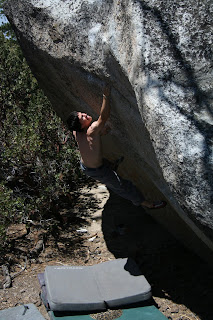
 At the Boulder Basin camp ground area we were able to find a hand full of fun problems to finish off the day. These were more concentrated and easier to find since we did not have to fight through thick brush and trees. Due to the longer drive and spread out nature of majority of the problems I think that Tramway a better area. Tram now has an excellent guidebook, that Black Mountain lacks, and will stay cooler longer into the summer.

So far the spring has been a bit strange out here in California. A week of perfect weather has been followed by a scorching weekend, causing us to retreat to the shade and higher altitudes. Two weeks back it was over 100 in LA County and a few fires have flared up.
April featured a trip to Bishop with some east coast friends that flew out to enjoy our spring weather. The temps in Bishop were perfect but on the second day of the trip the Buttermilks and Pollen Grains were getting 40 + MPH gusts. Not only did this bring a chill but it was hard to climb and scary to do anything tall since you could be blown off. We accidently did a bit of pad surfing as the crash pads went airborne even with people sitting on top of them.
The weekend after returning from Bishop we went to Black Mountain to avoid the heat and to continue with our bouldering bug. While the temps were nice and the setting was pristine I was not a fan of the problems. My skin was still tender from Bishop and most of the problems were lacking in either hand holds or foot holds. I enjoyed taking photos of my friends climbing and trying to learn how to deal with harsh light. My favorite problem was the Green Meanie slab which I had to start from atop my crash pad and a two foot pile of snow.
At the Boulder Basin camp ground area we were able to find a hand full of fun problems to finish off the day. These were more concentrated and easier to find since we did not have to fight through thick brush and trees. Due to the longer drive and spread out nature of majority of the problems I think that Tramway a better area. Tram now has an excellent guidebook, that Black Mountain lacks, and will stay cooler longer into the summer. While I was psyched to get into a bouldering mindset for a little while but I am happy that we were able to go sport climbing this weekend. A short trip to Malibu Creek helped me put my fitness into perspective. Climbing routes in the gym has helped keep me in shape and my endurance was adequate for the short routes. Since I haven’t lead anything hard outside in months I had to push to keep climbing while redpointing Urban Struggle. I kept it together and was happy to lead my first 5.12 since October.
I hope that this will be a good start to my sport climbing season and I am excited to go to Clark Mountain and Mt Charleston this summer! After a taste of limestone near Vegas in February I am excited to try some harder and steeper routes.
All photos are from Black Mountain.
Cheers,
I hope that this will be a good start to my sport climbing season and I am excited to go to Clark Mountain and Mt Charleston this summer! After a taste of limestone near Vegas in February I am excited to try some harder and steeper routes.
All photos are from Black Mountain.
Cheers,
Luke
Tuesday, March 11, 2008
What is Trad?
In late February Beth Rodden redpointed a new 5.14 in Yosemite. This 70 foot line is called Meltdown and features a thin finger crack that leads to discontinuous seams. Rodden placed all of her gear on lead after a winter of work on the line. Many think this is the hardest “trad” climb done by a woman and is quite an amazing send. The Alpinist has some info but better pictures and history about the route can big found on the BigUP blog. Beth will be featured climbing Meltdown and a few other hard climbs in Dosage V.
A Supertopo thread about Beth spurred a discussion about what is “Trad” and how you relate Trad to the rest of the categories of climbing. Does Trad imply that the ascent is done ground-up or does it just specify the style of gear used to protect a redpoint? While these markers of style are not essential to our sport it is interesting to see how they are interpreted. Does trad mean that there are no bolts on the line that are used for lead protection? I think that the meaning of trad has evolved since the original use of the word. I think that these days trad is most commonly used to mean something that is not a Sport climb. To me a trad climb simply implies you must place your own protection.
This makes me wonder where does mixed climbing falls? I mean mixed protection climbing which is not to be confused with mixed climbing that refers to a combination of rock and ice climbing where ice tools and crampons are used. A mixed route that offers both cams and bolts is some times referred to as a trad route since one must place some of your own protection. A good example of “Trad” climbing where bolts are used is seen in Red Rocks. Many of the climbs in Red Rocks have the ocational bolt when natural protection can not be found. I think of these as trad climbs despite the use of an occasional bolt for protection. These bolts are used when traditional protection can not be found and to keep the routes fairly safe. The safety issue comes in direct contrast to the bold bolt-free climbing style. In Red Rocks there is also an issue with some climbs that have been over bolted so that they are more accessible.
Beyond the type of gear used to protect a climb it is interesting that “Trad” can refer to the style of the ascent. Some say that a major distinction between Sport and Trad is whether the climb is done ground up or top down. “Traditional climbing means starting at the bottom and going to the top, without weighting pro. That, I put forth, is the traditional mindset.” This means that could you could climb a sport route in traditional style by sending ground up as opposed to rappelling it and inspecting it or hangdoging it and then redpointing it later. This seems a bit odd to me but it can make sense in the way climbs were established. A sport climb could have the bolts drilled on lead for a ground up ascent. I believe this was common practice before climbers started bolting on rappel. By establishing a climb top down you would eliminate the adventure by figuring out sequences in advance. I image this is why hang dogging was such heresy back when yo-yoing was the common practice.
Put in perspective of a traditional ground up ethic yo-yoing makes a bit more sense. By having to lower to the ground after a fall you would still have to be onsighting the upper most moves. Hangdoging allowed a climber to start from anywhere on a climb and slighted the ground up style. I can now see why there was so much debate on style and what is acceptable. If you fully believe in the Traditional spirt of climbing ground up without bolts then hangdogging while sport climbing (with bolts) is very much out of the question.
On Supertopo John Bachar goes on to specify the difference between Onsight and Onsight Flash. This was a distinction that I had never heard of and is way old school. In a way it does make sense in a world where when you fall you lower all the way to the ground (Yo-Yo style). Thus even though you have fallen you will eventually Onsight a climb since every move you will have at one point had to do for the first time until your eventual “Redpoint”. This seems strange in the current use of the word that is used to say that you did the climb first try all the way to the top without any beta.
It is odd that the distinction between Onsight and Onsight Flash seen above does not mention beta at all. I think this is a more interesting discussion. At what point do we cross the line from a Onsight to a Flash, in the modern sense of the words. Since climbing is just a type of game it is interesting that different people play by different rules. What I think is important is that you are honest about the style. If you call a send an Onsight but you had someone tell you about the climb then just be honest that your friend told you beta.
Style is important but it is more important to have fun and let everyone make their choices. We do not want to have anyone chipping routes or placing bolts right next to perfect natural protection. What has worked over the years is to allow different areas to feature their own set of rules and style of climbing. This can be a result of both the kind of rock and the mindset of the locals. So try to think outside the box and respect the traditions at the crags you frequent.
- Luke
A Supertopo thread about Beth spurred a discussion about what is “Trad” and how you relate Trad to the rest of the categories of climbing. Does Trad imply that the ascent is done ground-up or does it just specify the style of gear used to protect a redpoint? While these markers of style are not essential to our sport it is interesting to see how they are interpreted. Does trad mean that there are no bolts on the line that are used for lead protection? I think that the meaning of trad has evolved since the original use of the word. I think that these days trad is most commonly used to mean something that is not a Sport climb. To me a trad climb simply implies you must place your own protection.
This makes me wonder where does mixed climbing falls? I mean mixed protection climbing which is not to be confused with mixed climbing that refers to a combination of rock and ice climbing where ice tools and crampons are used. A mixed route that offers both cams and bolts is some times referred to as a trad route since one must place some of your own protection. A good example of “Trad” climbing where bolts are used is seen in Red Rocks. Many of the climbs in Red Rocks have the ocational bolt when natural protection can not be found. I think of these as trad climbs despite the use of an occasional bolt for protection. These bolts are used when traditional protection can not be found and to keep the routes fairly safe. The safety issue comes in direct contrast to the bold bolt-free climbing style. In Red Rocks there is also an issue with some climbs that have been over bolted so that they are more accessible.
Beyond the type of gear used to protect a climb it is interesting that “Trad” can refer to the style of the ascent. Some say that a major distinction between Sport and Trad is whether the climb is done ground up or top down. “Traditional climbing means starting at the bottom and going to the top, without weighting pro. That, I put forth, is the traditional mindset.” This means that could you could climb a sport route in traditional style by sending ground up as opposed to rappelling it and inspecting it or hangdoging it and then redpointing it later. This seems a bit odd to me but it can make sense in the way climbs were established. A sport climb could have the bolts drilled on lead for a ground up ascent. I believe this was common practice before climbers started bolting on rappel. By establishing a climb top down you would eliminate the adventure by figuring out sequences in advance. I image this is why hang dogging was such heresy back when yo-yoing was the common practice.
Put in perspective of a traditional ground up ethic yo-yoing makes a bit more sense. By having to lower to the ground after a fall you would still have to be onsighting the upper most moves. Hangdoging allowed a climber to start from anywhere on a climb and slighted the ground up style. I can now see why there was so much debate on style and what is acceptable. If you fully believe in the Traditional spirt of climbing ground up without bolts then hangdogging while sport climbing (with bolts) is very much out of the question.
On Supertopo John Bachar goes on to specify the difference between Onsight and Onsight Flash. This was a distinction that I had never heard of and is way old school. In a way it does make sense in a world where when you fall you lower all the way to the ground (Yo-Yo style). Thus even though you have fallen you will eventually Onsight a climb since every move you will have at one point had to do for the first time until your eventual “Redpoint”. This seems strange in the current use of the word that is used to say that you did the climb first try all the way to the top without any beta.
It is odd that the distinction between Onsight and Onsight Flash seen above does not mention beta at all. I think this is a more interesting discussion. At what point do we cross the line from a Onsight to a Flash, in the modern sense of the words. Since climbing is just a type of game it is interesting that different people play by different rules. What I think is important is that you are honest about the style. If you call a send an Onsight but you had someone tell you about the climb then just be honest that your friend told you beta.
Style is important but it is more important to have fun and let everyone make their choices. We do not want to have anyone chipping routes or placing bolts right next to perfect natural protection. What has worked over the years is to allow different areas to feature their own set of rules and style of climbing. This can be a result of both the kind of rock and the mindset of the locals. So try to think outside the box and respect the traditions at the crags you frequent.
- Luke
Thursday, February 14, 2008
ABS Nationals and Red Rocks!
ABS nationals is this weekend and we are flying out to boulder to compete and to help judge the Youth event. Lizzy’s sister is competing and so is Dan Beall, one of my friends from San Diego. We will also be seeing the ClimbingNarc and his team out from Wisconsin. Lizzy and I will be competing at the late Friday session at CATS for the citizen’s comp. It looks to be a small comp but it should be fun regardless and Lizzy is excited since Bobbi Bensman is going to be in our session.
Saturday we will be up early to help out with the Youth qualifiers which will be a new experience. It is just the experience I want since I would like to learn how to run comps and what makes good comps. Saturday night will be Open finals where we will see a crazy showdown of the top men and women from the US! There is extra pressure this year due to the upcoming Bouldeing World Cup in Vail, CO. It is pretty crazy that both Chris Sharma and Lisa Rands are coming back to compete. It will be great to see how the new generation does against these two super stars.
Sunday we will be judging Youth finals and then heading back to San Diego that night. Lizzy will be sticking around since she has the day off even though I have to work. After only two and half days of working we will be off on another trip to Red Rocks. Rebecca, one of my friends from college, will be flying out for an exciting four day multi-pitch extravaganza.
I did a bit of prep for this trip by going to Red Rocks last weekend. Lizzy was playing Frisbee in Vegas so one of her friends, Sean, and I took to the rocks with a vengeance. The gorgeous weather at Red Rocks allowed us to climb all day Friday and Saturday. Friday was moderate climbing with nothing over 5.9+ so we were able to do~ 1800 feet of climbing. We simuled Johnny Vegas to get to the upper tier of solar slab. From here we started with Sundog which was a fun 5 pitches with a funky 5.9+ bolted bulging groove. After rapping the route and resting our feet we decided to try to keep to our goals and climb Sunflower. This climb was a good bit harder and had a great finger crack and a run out crux friction pitch. After many repels, the last 4 in the dark, we got safely back to the ground.
The next day, with sore feet, we decided on the long hike to the Eagle wall. We set our eyes on Eagle’s Dance and were prepared for a bit harder climbing. Taking a more direct approach allowed us to cut 45 mins of the previous time I went to the Eagle wall. With perfect weather it was amazing that we had the wall practically to our selves the whole day. Our only visitor was a Peregrine Falcon that would occasionally dive past us. The climbing on this route was very sustained with only two of the nine pitches below 5.10. With a bunch of linking we were able to cut the route down to five pitches of mainly bolted climbing. The crux came after a short bolt ladder in the form of difficult stemming. The first section, supposedly only 10b was quite tricky and it took me a good while to believe that I should start climbing and leave the belay. After getting to good jams in the crack there was a rest on a slab and another crux section. This part was even more fierce and had amazing palming and laybacking in a slabby groove. I got buzzed by the falcon while I was placing gear and nearly popped off.
This was the last pitch and a relief for Sean who had been suffering from 20+ pitches of climbing in fairly new shoes. You could see the grimaces of pain each time he moved up on this footwork intensive route. We decided to take Sunday off and enjoy the sun and watch our girlfriends play ultimate. It was a great trip and I am really excited to go back!
A few weeks ago I got a tip from SpliterChoss about a 2 for 1 special and picked up a few guidebooks for paces I want to visit. In addition to the good price and they also had a drawing from those that bought books for a new rope. Magically I won!!! So I will be getting a new Stearling rope in addition too two cool guidebooks. I had been looking at Stearling ropes recently and was interested in seeing how they climb.
This has been a great month of climbing and it seems to only be getting better as we approach March and our week long Indian Creek Trip!!
Ciao!
- Luke
Saturday we will be up early to help out with the Youth qualifiers which will be a new experience. It is just the experience I want since I would like to learn how to run comps and what makes good comps. Saturday night will be Open finals where we will see a crazy showdown of the top men and women from the US! There is extra pressure this year due to the upcoming Bouldeing World Cup in Vail, CO. It is pretty crazy that both Chris Sharma and Lisa Rands are coming back to compete. It will be great to see how the new generation does against these two super stars.
Sunday we will be judging Youth finals and then heading back to San Diego that night. Lizzy will be sticking around since she has the day off even though I have to work. After only two and half days of working we will be off on another trip to Red Rocks. Rebecca, one of my friends from college, will be flying out for an exciting four day multi-pitch extravaganza.
I did a bit of prep for this trip by going to Red Rocks last weekend. Lizzy was playing Frisbee in Vegas so one of her friends, Sean, and I took to the rocks with a vengeance. The gorgeous weather at Red Rocks allowed us to climb all day Friday and Saturday. Friday was moderate climbing with nothing over 5.9+ so we were able to do~ 1800 feet of climbing. We simuled Johnny Vegas to get to the upper tier of solar slab. From here we started with Sundog which was a fun 5 pitches with a funky 5.9+ bolted bulging groove. After rapping the route and resting our feet we decided to try to keep to our goals and climb Sunflower. This climb was a good bit harder and had a great finger crack and a run out crux friction pitch. After many repels, the last 4 in the dark, we got safely back to the ground.
The next day, with sore feet, we decided on the long hike to the Eagle wall. We set our eyes on Eagle’s Dance and were prepared for a bit harder climbing. Taking a more direct approach allowed us to cut 45 mins of the previous time I went to the Eagle wall. With perfect weather it was amazing that we had the wall practically to our selves the whole day. Our only visitor was a Peregrine Falcon that would occasionally dive past us. The climbing on this route was very sustained with only two of the nine pitches below 5.10. With a bunch of linking we were able to cut the route down to five pitches of mainly bolted climbing. The crux came after a short bolt ladder in the form of difficult stemming. The first section, supposedly only 10b was quite tricky and it took me a good while to believe that I should start climbing and leave the belay. After getting to good jams in the crack there was a rest on a slab and another crux section. This part was even more fierce and had amazing palming and laybacking in a slabby groove. I got buzzed by the falcon while I was placing gear and nearly popped off.
This was the last pitch and a relief for Sean who had been suffering from 20+ pitches of climbing in fairly new shoes. You could see the grimaces of pain each time he moved up on this footwork intensive route. We decided to take Sunday off and enjoy the sun and watch our girlfriends play ultimate. It was a great trip and I am really excited to go back!
A few weeks ago I got a tip from SpliterChoss about a 2 for 1 special and picked up a few guidebooks for paces I want to visit. In addition to the good price and they also had a drawing from those that bought books for a new rope. Magically I won!!! So I will be getting a new Stearling rope in addition too two cool guidebooks. I had been looking at Stearling ropes recently and was interested in seeing how they climb.
This has been a great month of climbing and it seems to only be getting better as we approach March and our week long Indian Creek Trip!!
Ciao!
- Luke
Wednesday, January 23, 2008
Queen Creek Canyon
 For the long MLK weekend we ventured east for warm temps and to visit a new climbing area. Rebecca, one of my friend's from Bucknell, was visiting Phoenix for work and a climbing trip was born. We picked her up from the airport on Friday night after driving over from San Diego. Highway 8 is pretty desolate and we ran out of gas since the only service station in 80 miles was closed. We almost made it to the next one but ran out of gas just 10 miles short.
 A night in Phoneix meant an hour drive in the morning to the crag. When we arrived at the parking lot at 10am it was bitterly cold and windy. The crag could be seen, 200 feet above the road, on the side of the canyon. The cliffs were all south facing and were baking in the sun which was quite a bit warmer than the shady parking lot. We had chosen Queen Creek for this exact reason and it worked out perfectly.
 A quick hike up the trail and some 3rd class yielded access to the climbing. We were the fourth group at the crag and that number quickly grew throughout the day. The weather was perfect and you could easily wear T-shirts when you were climbing.
 The rock was a type of tuff that is formed out of solidified ash. The climbing was mainly vertical with lots of small pockets and crimps. There was not a lot of chalk on the routes which made finding the next hold a constant challenge.
Kyle, Rebecca, Lizzy and I had a ton of fun on the routes before lunch and had a few routes mostly to ourselves. We went around the corner to some longer routes and found quite the crowd of people. We ate lunch and waited for climbs to become free. Kyle, my climbing partner from SD, did a short climb and established a self belay on a pedestal so that he could take pictures of the nearby routes.
 The climb in the picture above was the coolest we did all trip. At 11b it had thin technical climbing up a seam to a good rest followed by a bit of easy climbing which led to the technical crux. A zig-zag traverse and then a bit of thin pocket pulling brought one to the anchors. The group climbing this route before us was a talented group of women accompanied by John Sherman. I had no idea that he sport climbed but he floated up this route. He also taught me that Guiness only has 10 calories per ounce, amazing right?
  Lizzy, enjoying the slabby small hold climbing this route offered, flashed the route which was her second of the grade. Kyle, in the photo above, and I also flashed the route with each of the three of us using different beta for both cruxes.
  Our second day we went to investigate the Looner crags in the Mine area. The climbs were on worse rock and were sparsely bolted. If you weren't near a crux there was no bolt. The climbing was still fun even though it was not as cool as the previous day.
 In preparation for her upcoming visit to Red Rocks, Rebecca lead a bunch of routes this trip. It was great to see her really push her limits on lead. She was climbing really strong and excelled on the sharp end.
 While Queen Creek is not a destination climbing area it was fun to be able to climb in such great weather in the winter time. Perhaps if we are visit phoenix again in the winter we will drop by.
 Cheers,
Luke
Thursday, November 29, 2007
Climbing Style – Effects of Traveling and Road Trips
Climbing well is more complex than just being strong and pulling down hard. Climbing is about being in touch with your body and understanding the style of movement required for a particular ascent. As climbers we travel for many reasons beyond the simple pursuit of cranking in new places. I enjoy the different scenery, rock texture and challenges provided by new areas. As well I am excited to climb local classics and learn a new style of movement. Traveling can allow a climber to increase their repertoire of moves as well as their fitness.
All over the world there are destination climbing areas and each has a bit of specialized style that allows a climber to excel in that area. Some skills are more easily translated between areas but others must be learned. Many people try to split climbing into three simple categories of bouldering, trad and sport each having a different style of movement. I think there are more subtle attributes to climbing than these divisions. The way a climber moves on routes at the red river gorge is very different than how they would at maple canyon, even though both are sport climbing areas. It comes down to the fact that steep cobbles provide an alternate challenge to pockets and sloping rails. Each of these styles requires different strengths and will teach climbers a specific skill.
While most areas provide a variety of hold types there are some where locals have clear advantage. Areas such as Horsepens have a very distinct style and can be very tricky for the traveling climber. Slopers the size and grain of horsepens are rare and require subtle movement and squeezing that has to be learned in order to send the local test pieces. Being able to spend many days figuring out the intricate of southern slopers will allow a climber to push themselves harder.
I have never been a true local at any climbing area. I have been a weekend warrior and sent all of my hardest climbs on road trips. Near the end of a stay at a climbing area I would have tailored my skills to fit the demands of the given rock type. Learning how to pull on the holds or how to keep the pump at bay would allow me to take the next step. Beyond just adapting to the style of the rock an extended trip would allow my body to flow better over rock. Constantly climbing for even a few days can give a climber a better awareness of how to pull and move their body.
The problem is that mentally it can be hard to climb at your limit if you keep mixing up the style you climb in. Bouldering one weekend on granite the next on sandstone and then sport climbing on limestone can put a person out of touch with how to move. A climber needs to balance variety so that they can still benefit from different challenges. It can be really annoying to switch rock types when you have finally dialed your footwork in one style. I think the key is to take something from each experience and try to apply it to the next; sometimes it will work even though other times it will be a step backwards.
When I started leading I was a sport climber and to this day I probably still am. I started trad leading a year or so later and it made convinced me that the Yosemite Decimal System could not relate bolted climbs to those where you had to place cams and nuts. There was no way I should get spanked so badly by a 5.9 crack when I could clip up 5.11.
Trad climbing came to me slowly and I started going through the grades. As I placed more gear and cam sizes became obvious I realized that it wasn’t trad climbing it self that could be more difficult but rather the type of routes that one would place gear on. Certain rock types and climbing areas lend them selves to particular types of routes. It wasn’t the gear placement that made the trad climb harder as much as the expectations of the route and the style of movement.
This past weekend, climbing out in Red Rocks, I found my self in a new situation. The end of the day yielded an onsight of both an 11a crack and an 11a face route but which had been more difficult? In recent times I have been trying to remove doubt I have had about falling while trad climbing. While I have not taken more than an eight foot fall on a cam I have been able to push my self to trust the gear more than when I first started. While I had to place gear on the crack I did this weekend I found the climb slightly easier than the face route. The jamming was slightly insecure but the line and sequence was more obvious and faster to decipher. For once it seemed that with the right mindset I could keep pushing into the next level for trad climbing.
With trad climbing and sport climbing, granite and sandstone, it is important to keep an open mind and keep learning. Don’t take bolts for granted and don’t forget how to place cams. Take each jamming experience and relate it to your latest crimpy test piece. While I believe that it may be beneficial to specialize in a style of climbing there is much more to gain from being an all around climber. It allows one to travel all over the world and climb classic routes without having to worry about bolts or hold types. Whatever way you take it go on a road trip and test your self in a new area!
- Luke
All over the world there are destination climbing areas and each has a bit of specialized style that allows a climber to excel in that area. Some skills are more easily translated between areas but others must be learned. Many people try to split climbing into three simple categories of bouldering, trad and sport each having a different style of movement. I think there are more subtle attributes to climbing than these divisions. The way a climber moves on routes at the red river gorge is very different than how they would at maple canyon, even though both are sport climbing areas. It comes down to the fact that steep cobbles provide an alternate challenge to pockets and sloping rails. Each of these styles requires different strengths and will teach climbers a specific skill.
While most areas provide a variety of hold types there are some where locals have clear advantage. Areas such as Horsepens have a very distinct style and can be very tricky for the traveling climber. Slopers the size and grain of horsepens are rare and require subtle movement and squeezing that has to be learned in order to send the local test pieces. Being able to spend many days figuring out the intricate of southern slopers will allow a climber to push themselves harder.
I have never been a true local at any climbing area. I have been a weekend warrior and sent all of my hardest climbs on road trips. Near the end of a stay at a climbing area I would have tailored my skills to fit the demands of the given rock type. Learning how to pull on the holds or how to keep the pump at bay would allow me to take the next step. Beyond just adapting to the style of the rock an extended trip would allow my body to flow better over rock. Constantly climbing for even a few days can give a climber a better awareness of how to pull and move their body.
The problem is that mentally it can be hard to climb at your limit if you keep mixing up the style you climb in. Bouldering one weekend on granite the next on sandstone and then sport climbing on limestone can put a person out of touch with how to move. A climber needs to balance variety so that they can still benefit from different challenges. It can be really annoying to switch rock types when you have finally dialed your footwork in one style. I think the key is to take something from each experience and try to apply it to the next; sometimes it will work even though other times it will be a step backwards.
When I started leading I was a sport climber and to this day I probably still am. I started trad leading a year or so later and it made convinced me that the Yosemite Decimal System could not relate bolted climbs to those where you had to place cams and nuts. There was no way I should get spanked so badly by a 5.9 crack when I could clip up 5.11.
Trad climbing came to me slowly and I started going through the grades. As I placed more gear and cam sizes became obvious I realized that it wasn’t trad climbing it self that could be more difficult but rather the type of routes that one would place gear on. Certain rock types and climbing areas lend them selves to particular types of routes. It wasn’t the gear placement that made the trad climb harder as much as the expectations of the route and the style of movement.
This past weekend, climbing out in Red Rocks, I found my self in a new situation. The end of the day yielded an onsight of both an 11a crack and an 11a face route but which had been more difficult? In recent times I have been trying to remove doubt I have had about falling while trad climbing. While I have not taken more than an eight foot fall on a cam I have been able to push my self to trust the gear more than when I first started. While I had to place gear on the crack I did this weekend I found the climb slightly easier than the face route. The jamming was slightly insecure but the line and sequence was more obvious and faster to decipher. For once it seemed that with the right mindset I could keep pushing into the next level for trad climbing.
With trad climbing and sport climbing, granite and sandstone, it is important to keep an open mind and keep learning. Don’t take bolts for granted and don’t forget how to place cams. Take each jamming experience and relate it to your latest crimpy test piece. While I believe that it may be beneficial to specialize in a style of climbing there is much more to gain from being an all around climber. It allows one to travel all over the world and climb classic routes without having to worry about bolts or hold types. Whatever way you take it go on a road trip and test your self in a new area!
- Luke
Wednesday, November 7, 2007
Levitation 29 part 2 - Dealing With Fear.
Climbing routes recently has been a mental push for me. I don’t know if it has to do with a low level of motivation or just being disconnected from the zone. I have been feeling a larger than normal amount of uncertainty with my climbing. Perhaps it has been all of the sport climbing and the disconnect from the do not fall mentality. Maybe climbing at my limit more often has given me more doubt. I don’t exactly know the cause but I hope to fight through it and figure out how to climb more confidently.
Doubting my ability comes into play when I climb because I am in the middle of a burn and I struggle to keep climbing, since I don’t feel I can do it. It has been a bit frustrating to have all of this doubt when there is no obvious cause. There seem to be a few different mind sets that I encounter when I am climbing. They range from a relaxing send, free from doubt, to a fearful onsight where I struggle to commit to every move. I think what is happening to me is that I am hesitating and unable to commit because I am afraid of failure. I am tied to the success related to sending the route and unable to fully commit my self because of fear.
My hardest trad onsight to date came on a tricky finger crack in Squamish called Crime of the Century. It was much harder than anything I had tried to onsight before. The lack of precedence allowed me to give everything. Even though it was very difficult I was less worried about failing to onsight the climb. This disconnect from having to send allowed me to be less hesitant and through a lot of grunting and hard work I got to the top.
This all relates to Levitation 29 because it is a route that has been in my mind for over a year now. The goal was to onsight the route and when the time came to go out and try the route this weekend there was a lot of intimidation. I was afraid that I would not be strong enough; I would be too tired after the long approach or that I would just fall/fail.
I had recently been training on longer sport routes but nothing would compare to a nine pitch route. Almost half of the pitches were 11a or harder and I would be leading all the hard pitches. While the crux fifth pitch would stand out as the technical crux of the route I would have to make sure to keep it together to the top.
The first hard pitch was the 2nd which I linked to the first. The climbing was fun and complex to a difficult crux. It seems height dependant as there are good holds but they were too far away for me to reach. This lead to some easier pitches which I followed and then the 5th pitch. The plan had been to skip bolts and link this to the next pitch for 150 feet of fun. As I started climbing up the climbing was harder than expected and I knew I would have to climb the pitches separately.
The crux of the 5th pitch started from a good 2 foot long hand jam sized pod. It moved from there up a few moves of laybacking into a fist pod with some bad face holds inside and a decent left hand crimp. You had good feet for the clip but had to move up to smears for the next move. This move, my crux, was a reach from either a bad fist jam(for my hands) or from the small but positive left crimp. I watched my right fist sliding out of the jam as I stabbed for the next finger lock. I got it and moved up to the next clip but I was physically and mentally fried.
I had spent so much time trying to find a better sequence through the crux that I was now really tired. The pitch did not ease up for many more clips so I really had to fight for the onsight. I wanted to send this route so bad and I knew that I could do it. This quote from this Steph Davis Blog was in the back of my mind as I kept refusing to let go.
“I’ve done all my groundwork. I am totally capable of doing this, and I know it for a fact, because I trained, practiced, meditated, and I am absolutely prepared to pull this off.”
I still climbed slowly and hesitantly through the pitch but I managed to make it to the anchors without falling. The next pitches were less difficult but I was still quite tired. I wonder if climbing the crux pitch faster would have been successful and saved me energy. I am still trying to figure out the best strategy for climbing onsight. I have to learn to work through my trust issues and climb with more certainty.
This climb was an amazing experience and I would be excited to go back and do it again. It pushed me both physically and mentally and I am still reflecting on the experience and learning lessons.
- Luke
Doubting my ability comes into play when I climb because I am in the middle of a burn and I struggle to keep climbing, since I don’t feel I can do it. It has been a bit frustrating to have all of this doubt when there is no obvious cause. There seem to be a few different mind sets that I encounter when I am climbing. They range from a relaxing send, free from doubt, to a fearful onsight where I struggle to commit to every move. I think what is happening to me is that I am hesitating and unable to commit because I am afraid of failure. I am tied to the success related to sending the route and unable to fully commit my self because of fear.
My hardest trad onsight to date came on a tricky finger crack in Squamish called Crime of the Century. It was much harder than anything I had tried to onsight before. The lack of precedence allowed me to give everything. Even though it was very difficult I was less worried about failing to onsight the climb. This disconnect from having to send allowed me to be less hesitant and through a lot of grunting and hard work I got to the top.
This all relates to Levitation 29 because it is a route that has been in my mind for over a year now. The goal was to onsight the route and when the time came to go out and try the route this weekend there was a lot of intimidation. I was afraid that I would not be strong enough; I would be too tired after the long approach or that I would just fall/fail.
I had recently been training on longer sport routes but nothing would compare to a nine pitch route. Almost half of the pitches were 11a or harder and I would be leading all the hard pitches. While the crux fifth pitch would stand out as the technical crux of the route I would have to make sure to keep it together to the top.
The first hard pitch was the 2nd which I linked to the first. The climbing was fun and complex to a difficult crux. It seems height dependant as there are good holds but they were too far away for me to reach. This lead to some easier pitches which I followed and then the 5th pitch. The plan had been to skip bolts and link this to the next pitch for 150 feet of fun. As I started climbing up the climbing was harder than expected and I knew I would have to climb the pitches separately.
The crux of the 5th pitch started from a good 2 foot long hand jam sized pod. It moved from there up a few moves of laybacking into a fist pod with some bad face holds inside and a decent left hand crimp. You had good feet for the clip but had to move up to smears for the next move. This move, my crux, was a reach from either a bad fist jam(for my hands) or from the small but positive left crimp. I watched my right fist sliding out of the jam as I stabbed for the next finger lock. I got it and moved up to the next clip but I was physically and mentally fried.
I had spent so much time trying to find a better sequence through the crux that I was now really tired. The pitch did not ease up for many more clips so I really had to fight for the onsight. I wanted to send this route so bad and I knew that I could do it. This quote from this Steph Davis Blog was in the back of my mind as I kept refusing to let go.
“I’ve done all my groundwork. I am totally capable of doing this, and I know it for a fact, because I trained, practiced, meditated, and I am absolutely prepared to pull this off.”
I still climbed slowly and hesitantly through the pitch but I managed to make it to the anchors without falling. The next pitches were less difficult but I was still quite tired. I wonder if climbing the crux pitch faster would have been successful and saved me energy. I am still trying to figure out the best strategy for climbing onsight. I have to learn to work through my trust issues and climb with more certainty.
This climb was an amazing experience and I would be excited to go back and do it again. It pushed me both physically and mentally and I am still reflecting on the experience and learning lessons.
- Luke
Monday, November 5, 2007
Levitation 29
So we just got back from Las Vegas and the ever-impressive Red Rocks. Overall it was a really successful weekend.
On Friday morning we drove out to Vegas and after picking up the 2 new guidebooks (both of which are excellent and highly recommended!) and procuring a campsite (which was good because the campground was full when we got back that night) we headed out to Black Velvet Canyon. We've done a couple routes out here before - Prince of Darkness (5.10c, 6 pitches, lots of bolts) and Epinephrine (5.9, 13 pitches, lots of chimneys, we topped out after dark and nearly epic-ed the descent with tricky cairn-finding in the dark). So the approach was no big surprise. We finally got to climb Dream of Wild Turkeys (5.10a, 7 pitches), which was super fun. I followed the last pitch in semi-dark and we rapped and got back to the car safely, where we had some yummy breakfast burritos for dinner in the parking lot.
After passing out before 10pm on Friday night, we awoke early on Saturday morning to head out to Levitation 29. We left the Oak Creek Canyon parking lot at about 6:45am after lots of repacking of bags, breakfast, and the several miles of loop road preceding the parking lot. I've climbed Johnny Vegas, Solar Slab, and Black Orpheus before, so the first bit of the approach was already familiar to me. We made really good time hiking up the wash to the Black Orpheus approach, although we still had tons of wash to hike up. We had hoped to take a shortcut (approximately following the Black Orpheus descent I think), but due to a misunderstanding ended up hiking the standard (long) approach that goes up the wash to the really big pine trees. But it was ok because we were the first to the base of the route and actually had Eagle Wall entirely to ourselves save for two guys who climbed part of Eagle Dance.
Luke linked the first 2 pitches into one and I followed, unfortunately falling at the 5.11b roof crux. I lead the next two easier pitches (5.8, 5.10b) which were really fun, getting us to the base of the crux pitch, which Luke lead brilliantly :-D I fell once at the crux of this pitch, struggling with a wide pod that I couldn't even fist jam. The pitch was surprisingly sustained and I was really tired after following it. The next pitch was a little less steep, but still quite hard with many small crimps (which were very common on the route). This was followed by a weird, hard pitch with some rather crappy-quality white rock. I fell near the top of this pitch at some strenuous layback moves - my hands were cramping so badly I was losing motor control of my fingers - not able to keep holding on. Then there were just 2 more pitches, which Luke lead for me (and linked) to the top featuring some more sketchy rock. Hoping to use the remaining light to get back to the wash the faster way, we rapped immediately from the top of the 9th pitch (where we saw some climbers topping out Black Orpheus). We got to the ground with some light to spare, and started working our way down the wash. We ended up at some sketchy steep downslabbing in the dark, but found a rap station and rapped/bushwhacked our way back into the wash, making it back to the car by 8pm.
It was a great experience and a huge challenge for me and for us. The hiking took us about 2.5 hours each way, which added to the challenge of the route due to the shortness of the November days. The hard pitches of the route were a lot more challenging than I might have expected and I really struggled with keeping up my energy throughout the day. We left our sandwiches at the base to be lighter, so I ended up doing most of the climb on a package of shot blocks, a gu, and a clif bar, which considering the difficulty of the route was probably nowhere near enough food. We also only brought 2.5 liters of water, so I think both of us were also pretty dehydrated, which contributed to both of us getting cramps in our hands (which had never happened to me before). It's made me think a lot about how we could have addressed this problem better - different food, more food, supplementing our water with some gatorade, or maybe even a potassium supplement to fight the cramps. These are really important things to consider and learn about because as we push ourselves more it's only going to become more critical to be adequately hydrated and fed to be able to function and achieve at a higher level.
I do think all our efforts to improve our efficiency did help us out, though, because our belay transfers were in general fairly efficient and (due to the bolted belays) were able to keep the wasted or excessive gear to a minimum.
Hopefully this is just a starting point for us for climbing routes of this quality and caliber of difficulty. We were dreaming on the route back about future projects in Red Rocks, including Cloud Tower and the Original Route on the Rainbow Wall, both of which involve much harder cruxes and (in the case of the Rainbow Wall) long approaches.
I'm sure Luke will have more things to say about Levitation 29... what a day...
On Friday morning we drove out to Vegas and after picking up the 2 new guidebooks (both of which are excellent and highly recommended!) and procuring a campsite (which was good because the campground was full when we got back that night) we headed out to Black Velvet Canyon. We've done a couple routes out here before - Prince of Darkness (5.10c, 6 pitches, lots of bolts) and Epinephrine (5.9, 13 pitches, lots of chimneys, we topped out after dark and nearly epic-ed the descent with tricky cairn-finding in the dark). So the approach was no big surprise. We finally got to climb Dream of Wild Turkeys (5.10a, 7 pitches), which was super fun. I followed the last pitch in semi-dark and we rapped and got back to the car safely, where we had some yummy breakfast burritos for dinner in the parking lot.
After passing out before 10pm on Friday night, we awoke early on Saturday morning to head out to Levitation 29. We left the Oak Creek Canyon parking lot at about 6:45am after lots of repacking of bags, breakfast, and the several miles of loop road preceding the parking lot. I've climbed Johnny Vegas, Solar Slab, and Black Orpheus before, so the first bit of the approach was already familiar to me. We made really good time hiking up the wash to the Black Orpheus approach, although we still had tons of wash to hike up. We had hoped to take a shortcut (approximately following the Black Orpheus descent I think), but due to a misunderstanding ended up hiking the standard (long) approach that goes up the wash to the really big pine trees. But it was ok because we were the first to the base of the route and actually had Eagle Wall entirely to ourselves save for two guys who climbed part of Eagle Dance.
Luke linked the first 2 pitches into one and I followed, unfortunately falling at the 5.11b roof crux. I lead the next two easier pitches (5.8, 5.10b) which were really fun, getting us to the base of the crux pitch, which Luke lead brilliantly :-D I fell once at the crux of this pitch, struggling with a wide pod that I couldn't even fist jam. The pitch was surprisingly sustained and I was really tired after following it. The next pitch was a little less steep, but still quite hard with many small crimps (which were very common on the route). This was followed by a weird, hard pitch with some rather crappy-quality white rock. I fell near the top of this pitch at some strenuous layback moves - my hands were cramping so badly I was losing motor control of my fingers - not able to keep holding on. Then there were just 2 more pitches, which Luke lead for me (and linked) to the top featuring some more sketchy rock. Hoping to use the remaining light to get back to the wash the faster way, we rapped immediately from the top of the 9th pitch (where we saw some climbers topping out Black Orpheus). We got to the ground with some light to spare, and started working our way down the wash. We ended up at some sketchy steep downslabbing in the dark, but found a rap station and rapped/bushwhacked our way back into the wash, making it back to the car by 8pm.
It was a great experience and a huge challenge for me and for us. The hiking took us about 2.5 hours each way, which added to the challenge of the route due to the shortness of the November days. The hard pitches of the route were a lot more challenging than I might have expected and I really struggled with keeping up my energy throughout the day. We left our sandwiches at the base to be lighter, so I ended up doing most of the climb on a package of shot blocks, a gu, and a clif bar, which considering the difficulty of the route was probably nowhere near enough food. We also only brought 2.5 liters of water, so I think both of us were also pretty dehydrated, which contributed to both of us getting cramps in our hands (which had never happened to me before). It's made me think a lot about how we could have addressed this problem better - different food, more food, supplementing our water with some gatorade, or maybe even a potassium supplement to fight the cramps. These are really important things to consider and learn about because as we push ourselves more it's only going to become more critical to be adequately hydrated and fed to be able to function and achieve at a higher level.
I do think all our efforts to improve our efficiency did help us out, though, because our belay transfers were in general fairly efficient and (due to the bolted belays) were able to keep the wasted or excessive gear to a minimum.
Hopefully this is just a starting point for us for climbing routes of this quality and caliber of difficulty. We were dreaming on the route back about future projects in Red Rocks, including Cloud Tower and the Original Route on the Rainbow Wall, both of which involve much harder cruxes and (in the case of the Rainbow Wall) long approaches.
I'm sure Luke will have more things to say about Levitation 29... what a day...
Tuesday, October 30, 2007
Long-term projects (a.k.a. dreams)
Long-term projects. I would hazard a guess that every climber has at least one. I have a lot. They're the climbs that you dream about. That page in the guidebook you just have to look at. The dream. The goal to train for.
My list is much longer than you'd ever want to read (and the relative importances of different projects are nowhere near the same), but at the moment there are three that capture my desire and imagination much more than any others...
Sunshine Dihedral, 5.11d, Smith Rock. I first saw this route right after I'd onsighted it's neighbor, Moonshine Dihedral, 5.9, which was my hardest onsight (trad or sport) at the time. A beautiful, perfect, soaring dihedral with a tips and fingers crack that is ideally suited to my smaller fingers. Delicate and technical stemming, one of my favorite types of climb because the movements feel so natural to me and even the unusual body positions seem to flow so easily. I have only touched the bottom of the route, but I'd like to train enough to give it an onsight go (maybe if we get out to Smith this next June) because such a beautiful route deserves it.
Coyne Crack, 5.12, Indian Creek. I've never been to Indian Creek, but I dream about it all the time. This route, to me, exemplifies the reasons behind my desire for IC. Vertical, perfect splitter. A difficult start with a section of mandatory off-finger jams (for any hand-size) leads to red camalots forever (which just happens to be my perfect hand jam size). The idea of the route is so motivating - a sequence of some of the most challenging size jams right off the ground followed by the sweetest reward of running up perfect jams. What makes it more exciting is that I have no idea how my abilities stack up against the route, how hard that beginning section will be, whether or not I will get pumped from all those hand jams up higher. But the chance to go to IC (in March!!) is a dream - so much straightforward jamming, so many different routes to try, skills to test and improve. Crack climbing heaven :-D
And last, but certainly not least, the crown jewel of my dream routes,
Equinox, 5.12+, Joshua Tree. I first stumbled upon this route online and immediately fell in love. Such a steep, perfect crack is really unusual for J-Tree and I knew I had to see it, to feel it, even though it was (and still is) far above my ability to lead. The location is incredible. After driving several miles out Geology Tour road, you walk out into the desert towards one of those big jumbled piles of rocks so particular to J-Tree. The excitement builds as you approach the formation, because you can't see the route until you are quite close. But then you round the curve of the base and there it is - a clean, beautiful crack curving gently up the vertical face of the largest granite block, perched on the top of the pile. I couldn't believe it could be so perfect, that the setting could be so fitting to the beauty of the crack. And then there's the crack itself. It starts with a crazy move pulling onto an ear-shaped flake, then some nice finger jamming (green alien, which is perfect fingers for me, but my fingers are small...) with less than awesome feet (the trend of non-stellar feet continues most of the way up the route because the face is a little slick for smearing and the crack a little small to really be effective jamming your toes in). And then you get into the fun part. As the crack widens to yellow aliens, you pull through a dead-vertical/slightly overhanging section and the crack continues to widen. That's when it gets really hard - grey aliens, somewhat offset, and left-leaning. This size is the hardest I have ever encountered for me personally because it's not quite ring locks or thin hands, but that nasty size in between where nothing feels secure (luckily the two times I've tried it I was on TR so I haven't had to take the whip... yet...). This crux is followed by an increasingly easier traverse left as footholds (!!!) appear when you hand-traverse the crack to the top. Although it has so far proven incredibly difficult for me, I can't help but be motivated and inspired by this route. It is so pure and so beautiful, the ultimate project. (By the way, if you are reading this and happen to be someone short with small fingers who has send Equinox, I'd love some advice for the hard part.)
So those are my dream projects. I think it's really important to have routes that inspire and motivate me. I can often be too much of an aesthetically motivated climber for my own good (although I've been sending harder at the Riverside Quarry, which isn't exactly picturesque), struggling with routes that don't get my heart beating faster. But I find that when I have my goal routes, it's easier to motivate on other climbs that I would otherwise struggle with motivation because I can see them as a stepping stone towards the ultimate goal. That off-size crack in the gym? That's training for Jaws (Mt. Woodson, hopefully not too burned up). And Jaws, well campusing that is training for Equinox.
In related news, this weekend Luke and I are going to try to onsight one of our other long-term projects, Levitation 29, III 5.11, in Red Rocks, so wish us luck!
My list is much longer than you'd ever want to read (and the relative importances of different projects are nowhere near the same), but at the moment there are three that capture my desire and imagination much more than any others...
Sunshine Dihedral, 5.11d, Smith Rock. I first saw this route right after I'd onsighted it's neighbor, Moonshine Dihedral, 5.9, which was my hardest onsight (trad or sport) at the time. A beautiful, perfect, soaring dihedral with a tips and fingers crack that is ideally suited to my smaller fingers. Delicate and technical stemming, one of my favorite types of climb because the movements feel so natural to me and even the unusual body positions seem to flow so easily. I have only touched the bottom of the route, but I'd like to train enough to give it an onsight go (maybe if we get out to Smith this next June) because such a beautiful route deserves it.
Coyne Crack, 5.12, Indian Creek. I've never been to Indian Creek, but I dream about it all the time. This route, to me, exemplifies the reasons behind my desire for IC. Vertical, perfect splitter. A difficult start with a section of mandatory off-finger jams (for any hand-size) leads to red camalots forever (which just happens to be my perfect hand jam size). The idea of the route is so motivating - a sequence of some of the most challenging size jams right off the ground followed by the sweetest reward of running up perfect jams. What makes it more exciting is that I have no idea how my abilities stack up against the route, how hard that beginning section will be, whether or not I will get pumped from all those hand jams up higher. But the chance to go to IC (in March!!) is a dream - so much straightforward jamming, so many different routes to try, skills to test and improve. Crack climbing heaven :-D
And last, but certainly not least, the crown jewel of my dream routes,
Equinox, 5.12+, Joshua Tree. I first stumbled upon this route online and immediately fell in love. Such a steep, perfect crack is really unusual for J-Tree and I knew I had to see it, to feel it, even though it was (and still is) far above my ability to lead. The location is incredible. After driving several miles out Geology Tour road, you walk out into the desert towards one of those big jumbled piles of rocks so particular to J-Tree. The excitement builds as you approach the formation, because you can't see the route until you are quite close. But then you round the curve of the base and there it is - a clean, beautiful crack curving gently up the vertical face of the largest granite block, perched on the top of the pile. I couldn't believe it could be so perfect, that the setting could be so fitting to the beauty of the crack. And then there's the crack itself. It starts with a crazy move pulling onto an ear-shaped flake, then some nice finger jamming (green alien, which is perfect fingers for me, but my fingers are small...) with less than awesome feet (the trend of non-stellar feet continues most of the way up the route because the face is a little slick for smearing and the crack a little small to really be effective jamming your toes in). And then you get into the fun part. As the crack widens to yellow aliens, you pull through a dead-vertical/slightly overhanging section and the crack continues to widen. That's when it gets really hard - grey aliens, somewhat offset, and left-leaning. This size is the hardest I have ever encountered for me personally because it's not quite ring locks or thin hands, but that nasty size in between where nothing feels secure (luckily the two times I've tried it I was on TR so I haven't had to take the whip... yet...). This crux is followed by an increasingly easier traverse left as footholds (!!!) appear when you hand-traverse the crack to the top. Although it has so far proven incredibly difficult for me, I can't help but be motivated and inspired by this route. It is so pure and so beautiful, the ultimate project. (By the way, if you are reading this and happen to be someone short with small fingers who has send Equinox, I'd love some advice for the hard part.)
So those are my dream projects. I think it's really important to have routes that inspire and motivate me. I can often be too much of an aesthetically motivated climber for my own good (although I've been sending harder at the Riverside Quarry, which isn't exactly picturesque), struggling with routes that don't get my heart beating faster. But I find that when I have my goal routes, it's easier to motivate on other climbs that I would otherwise struggle with motivation because I can see them as a stepping stone towards the ultimate goal. That off-size crack in the gym? That's training for Jaws (Mt. Woodson, hopefully not too burned up). And Jaws, well campusing that is training for Equinox.
In related news, this weekend Luke and I are going to try to onsight one of our other long-term projects, Levitation 29, III 5.11, in Red Rocks, so wish us luck!
Grades, Grades, Grades…
As I have been attempting more “hard” routes recently I have been mulling over the concept of grades. Within a given number, whether 5.9 or 5.13, the variability of perceived difficulty can be quite vast. Rock type can vary between crags as can the grading ethics and the style of climbing. How can we relate a 5.9 on Yosemite granite to a 5.9 at the Red River Gorge?
At one point our grading system rated a climb based on its hardest move, but now we try to rate the overall effort required for a climb. Sustained 5.9 moves yield a rating of 5.10a at certain crags despite the lack of a 10a move. These ideas are not set in stone nor are the agreed upon throughout the world, yet people all over base so much on these simple numbers. Is this because we need an expectation for the route we are going to climb? Do we need compare climbs to each other and to our past climbs? What do we need from these grades?
I found this quote about Dave Graham’s feelings on grades quite interesting. It was originally posted here.
"Do we comprehend as a community a system of grading? As a community, are we confident in our current theories about the complex abstraction of high-end grades?
I think the media did a lot more consolidating of grades than we ever did as a community of climbers. For generations it has happened. Capitalism, money, "fame",...these factors of our world are real, and they have a serious influence.
Grades will never be the most inspiring abstraction donated by climbing. They rank low in overall importance. From an artistic point of view, the possible inspiration one can attain from a grade (it being an after-the-fact interpretation of something special) can never compete with the inspiration donated by the actual experience of climbing.
I changed a lot of my ideas about grades throughout my experiences climbing. I learned a lot about how to compare personal experiences and deduce their relativity. I think its amazing, as a community, how everyone involved, can appreciate the attempt to articulate (with a little number) how challenging something felt, or how one experience compared to another."
--- Dave Graham, 2004 ---
I completely agree that climbing is too complex to be expressed by “a little number”. As a community we should work together to push the limits of climbing and make sure not to be confined by grades.
This article really sheds some light on the John Gill B scale. It is cool to see that a younger climber, Klem Loskot, agrees and his explanation of how to grade problems that are so difficult. It is especially important how he says that grades should really just be a personal reflection of the difficulty of a climb. As well that sometimes the best way to look at the difficulty of a problem can be its relation to other climbs you have done.
Personally I use grades as a measure of performance and a way to gauge progress. I target grade ranges when I travel to crags so that I will push my self climbing. In the past I have been too concerned with sending given grades at the sacrifice of other parts of climbing. I would climb 11as instead 10ds since they are the next number grade up and thus more important even thought both grades be quite similar in difficulty.
While I do think the grades do characterize different types of movement I can still be surprised by the effort required to do 5.9 versus 5.12. Just because a climb is graded harder doesn’t always mean it is more difficult. Difficulty is so abstract, especially in climbing, because there is a varied mix of mental and physical effort. A climb can seem more difficult if the moves are harder to unlock compared to a climb with simple pulling.
Overall I think that the most important thing is to keep climbing and trying different styles of routes. A person’s body can learn so much from a variety of challenges. After man years of climbing cruxes will make more sense and perhaps grades will seem less important. The key is to challenge yourself and have fun doing it.
- Luke
At one point our grading system rated a climb based on its hardest move, but now we try to rate the overall effort required for a climb. Sustained 5.9 moves yield a rating of 5.10a at certain crags despite the lack of a 10a move. These ideas are not set in stone nor are the agreed upon throughout the world, yet people all over base so much on these simple numbers. Is this because we need an expectation for the route we are going to climb? Do we need compare climbs to each other and to our past climbs? What do we need from these grades?
I found this quote about Dave Graham’s feelings on grades quite interesting. It was originally posted here.
"Do we comprehend as a community a system of grading? As a community, are we confident in our current theories about the complex abstraction of high-end grades?
I think the media did a lot more consolidating of grades than we ever did as a community of climbers. For generations it has happened. Capitalism, money, "fame",...these factors of our world are real, and they have a serious influence.
Grades will never be the most inspiring abstraction donated by climbing. They rank low in overall importance. From an artistic point of view, the possible inspiration one can attain from a grade (it being an after-the-fact interpretation of something special) can never compete with the inspiration donated by the actual experience of climbing.
I changed a lot of my ideas about grades throughout my experiences climbing. I learned a lot about how to compare personal experiences and deduce their relativity. I think its amazing, as a community, how everyone involved, can appreciate the attempt to articulate (with a little number) how challenging something felt, or how one experience compared to another."
--- Dave Graham, 2004 ---
I completely agree that climbing is too complex to be expressed by “a little number”. As a community we should work together to push the limits of climbing and make sure not to be confined by grades.
This article really sheds some light on the John Gill B scale. It is cool to see that a younger climber, Klem Loskot, agrees and his explanation of how to grade problems that are so difficult. It is especially important how he says that grades should really just be a personal reflection of the difficulty of a climb. As well that sometimes the best way to look at the difficulty of a problem can be its relation to other climbs you have done.
Personally I use grades as a measure of performance and a way to gauge progress. I target grade ranges when I travel to crags so that I will push my self climbing. In the past I have been too concerned with sending given grades at the sacrifice of other parts of climbing. I would climb 11as instead 10ds since they are the next number grade up and thus more important even thought both grades be quite similar in difficulty.
While I do think the grades do characterize different types of movement I can still be surprised by the effort required to do 5.9 versus 5.12. Just because a climb is graded harder doesn’t always mean it is more difficult. Difficulty is so abstract, especially in climbing, because there is a varied mix of mental and physical effort. A climb can seem more difficult if the moves are harder to unlock compared to a climb with simple pulling.
Overall I think that the most important thing is to keep climbing and trying different styles of routes. A person’s body can learn so much from a variety of challenges. After man years of climbing cruxes will make more sense and perhaps grades will seem less important. The key is to challenge yourself and have fun doing it.
- Luke
Monday, October 22, 2007
Red River Gorge Reflection
This past week, after returning from the RRG, has been super busy without the normal regiment of climbing. Since we got back late Monday I had some hours to make up at work and some sleep to regain. The four days of climbing and travel took a lot out of me so I decided to take some days off from the gym to recover. I didn’t get back to the gym until Thursday and my finger was still nagging me from the trip.
For the last few weeks one of my old tendon injuries has been acting up. It doesn’t really hurt when I climb but afterwards the flesh below my knuckle is quite tender to the touch. This weekend became a rest weekend and I had some additional time to recover. I hope to write a blog later this week about injures referencing some of Lynn Hill’s recent blogs.
The lack of climbing and the recent RRG trip have given me food for thought about “hard” climbing. During our stay at Miguel’s I saw more talented climbers than I have ever seen before. It was almost like Dosage 5 or something. I have been to some bigger comps and have seen many of the stronger boulders before but this was something new and inspirational. After seeing all the climbers and reading about their many ascents at the Red I began to wonder about my personal climbing.
The beauty of having all of these talented climbs was that they were sending routes that I was familiar with. Climbs I had stood below in awe of the beauty and difficulty of the line. Not climbs I had sent or even tried but climbs that I dream about getting on. These were climbs not far away on the gorgeous cliffs of Ceuse but here in the USA in the RED!
This trip really taught me a lot about motivation, hesitation and mind set. Of the nine hard routes that I attempted I was able to send five of them. Compared to past trips to the Red I was thrilled with my level of fitness and the climbs I did. More important though were the climbs that I “failed” to lead cleanly. Even the attempts on the climbs I did send taught me a lot about what I need to be working on.
The biggest thing I learned from trying all of these hard routes was the effect of hesitation on the outcome of the climb. In simpler terms when I failed to commit to a move or sequence on a climb I would waste time. There were times when I could have done a move had I tried it first go but I was un-willing to commit. These decisions made me doubt my self and prevented me from giving the 100% needed for the climb.
While my fitness has been improving I think that figuring out how to commit and how to suppress negative thoughts will be a bigger contribution to my climbing. Climbing more routes, as opposed to boulder problems, has really shown me this weakness in my climbing.I think working on this will help me be in better touch with my self and allow me to climb harder.
For the last few weeks one of my old tendon injuries has been acting up. It doesn’t really hurt when I climb but afterwards the flesh below my knuckle is quite tender to the touch. This weekend became a rest weekend and I had some additional time to recover. I hope to write a blog later this week about injures referencing some of Lynn Hill’s recent blogs.
The lack of climbing and the recent RRG trip have given me food for thought about “hard” climbing. During our stay at Miguel’s I saw more talented climbers than I have ever seen before. It was almost like Dosage 5 or something. I have been to some bigger comps and have seen many of the stronger boulders before but this was something new and inspirational. After seeing all the climbers and reading about their many ascents at the Red I began to wonder about my personal climbing.
The beauty of having all of these talented climbs was that they were sending routes that I was familiar with. Climbs I had stood below in awe of the beauty and difficulty of the line. Not climbs I had sent or even tried but climbs that I dream about getting on. These were climbs not far away on the gorgeous cliffs of Ceuse but here in the USA in the RED!
This trip really taught me a lot about motivation, hesitation and mind set. Of the nine hard routes that I attempted I was able to send five of them. Compared to past trips to the Red I was thrilled with my level of fitness and the climbs I did. More important though were the climbs that I “failed” to lead cleanly. Even the attempts on the climbs I did send taught me a lot about what I need to be working on.
The biggest thing I learned from trying all of these hard routes was the effect of hesitation on the outcome of the climb. In simpler terms when I failed to commit to a move or sequence on a climb I would waste time. There were times when I could have done a move had I tried it first go but I was un-willing to commit. These decisions made me doubt my self and prevented me from giving the 100% needed for the climb.
While my fitness has been improving I think that figuring out how to commit and how to suppress negative thoughts will be a bigger contribution to my climbing. Climbing more routes, as opposed to boulder problems, has really shown me this weakness in my climbing.I think working on this will help me be in better touch with my self and allow me to climb harder.
Wednesday, October 17, 2007
Petzl Roc Trip Recap
This past weekend Lizzy and I journeyed east to meet up with friends and enjoy the rock at the Red River Gorge. Friends from all over converged by plane and car to meet up relax and enjoy the wondrous sandstone. Good people along with an amazing film and the most stacked campground scene rounded out this fun trip.
A Wednesday night red eye from California got us into Tennessee the next morning. A 3.5 hour drive awaited us but that was the price for cheap tickets. With perfect temps we spent the afternoon at Roadside crag sampling the RRG classics before the crowds showed up.
Friday our crew had doubled and we spent the day between Left Flank and Military Wall. Climbing at the gorgeous table of colors wall was the highlight of the trip for me. Amazing colors and unique holds coupled with steep athletic climbing. Near by was the balancy test piece Hen-ry which played to Lizzy’s strengths. I got to climb Mercy the Huff which had excellent moves on sweet holds separated by fairly decent rests. No knee bars or ledges but good holds.
Saturday we saw maximum capacity with seven people by the end of the day. We had a perfect weather day at Drive-By crag which hosts some of the most fun climbing ever. It seemed each route had just as interesting holds as the last. I took my longest fall to date on a flash attempt on Primus Noctum. I cruised the route to the last bolt and rest spot but I had no beta for the crux which led to the anchor. With many grunts and desperation I slapped my way up getting one hold from the end; I missed the crucial knob and plummeted twenty or more feet through the air. On the way down I screamed with desperation but after flying through a tree and knocking loose some leaves I knew it was all right. Still falling I let out a yipp of pleasure and was gently caught by my belayer.
Sunday was our slow day as pizza and beer from the night before delayed our morning departure. We fought the crowds in Muir valley and climbed on some new routes. These routes, only having been established in the last few years, were still dirty and needed more traffic. I got a chance to lead a very atypical RRG line that I managed to redpoint on my second go. This line, so new it wasn’t in the guide book, was full of slopers and balancy moves. The end, with pumped forearms, required sequential crimping that thwarted my flash attempt. It was amazing how many lines are still left to be bolted and how much rock is still unclimbed. I was lucky enough to meet the equipper of this route and brave enough to climb it.
The trip was quite the success and full of fun memories. My mind is still buzzing with crux sequences and foot placements. I can still see the holds on Jersey Connection and Tic-Tac-Toe, feel the sharp jugs from Mercy the Huff and taste the scream from Primus Noctum. I love the Red and will always be excited to go back, no matter how far way it may be.
A Wednesday night red eye from California got us into Tennessee the next morning. A 3.5 hour drive awaited us but that was the price for cheap tickets. With perfect temps we spent the afternoon at Roadside crag sampling the RRG classics before the crowds showed up.
Friday our crew had doubled and we spent the day between Left Flank and Military Wall. Climbing at the gorgeous table of colors wall was the highlight of the trip for me. Amazing colors and unique holds coupled with steep athletic climbing. Near by was the balancy test piece Hen-ry which played to Lizzy’s strengths. I got to climb Mercy the Huff which had excellent moves on sweet holds separated by fairly decent rests. No knee bars or ledges but good holds.
Saturday we saw maximum capacity with seven people by the end of the day. We had a perfect weather day at Drive-By crag which hosts some of the most fun climbing ever. It seemed each route had just as interesting holds as the last. I took my longest fall to date on a flash attempt on Primus Noctum. I cruised the route to the last bolt and rest spot but I had no beta for the crux which led to the anchor. With many grunts and desperation I slapped my way up getting one hold from the end; I missed the crucial knob and plummeted twenty or more feet through the air. On the way down I screamed with desperation but after flying through a tree and knocking loose some leaves I knew it was all right. Still falling I let out a yipp of pleasure and was gently caught by my belayer.
Sunday was our slow day as pizza and beer from the night before delayed our morning departure. We fought the crowds in Muir valley and climbed on some new routes. These routes, only having been established in the last few years, were still dirty and needed more traffic. I got a chance to lead a very atypical RRG line that I managed to redpoint on my second go. This line, so new it wasn’t in the guide book, was full of slopers and balancy moves. The end, with pumped forearms, required sequential crimping that thwarted my flash attempt. It was amazing how many lines are still left to be bolted and how much rock is still unclimbed. I was lucky enough to meet the equipper of this route and brave enough to climb it.
The trip was quite the success and full of fun memories. My mind is still buzzing with crux sequences and foot placements. I can still see the holds on Jersey Connection and Tic-Tac-Toe, feel the sharp jugs from Mercy the Huff and taste the scream from Primus Noctum. I love the Red and will always be excited to go back, no matter how far way it may be.
Tuesday, October 9, 2007
Resting and Redpointing
This weekend was my long weekend and it involved a bunch of climbing. Training has been going well with a bit more focus on power problems and campusing. I would like to get back to some more pure endurance training but I am without a belayer.
Friday afternoon Lizzy and I struggled through traffic to get to the Riverside Quarry. Despite its less than aesthetic surroundings I am a big fan of the routes there. While many have been heavily cleaned and glued most are natural lines without chipping. As well most of the lines are quite long a minimum of 7 bolts and the longest line is 21 going for almost a full 60 meters.
Since we arrived late we only climbed a few routes. For training and for timeliness we stuck to onsight climbing and the same routes. I climbed an extension of Lizzy’s warm-up called double whammy. It had a tricky crux with a cool sloper and a powerful gaston high foot combination. This route was super typical of the quarry with mostly easier climbing to a stopper crux if you don’t commit.
The style of the routes at the quarry is very different to those we had be climbing out at echo. While both offer vertical climbing with possible hands free rests the hold consistency is very different. The quarry can have huge jugs quite close to tiny crimpers. The most constant part of the selection of holds at the quarry is that they are far apart. Echo usually has very similar hold size and type that leads to much more sustained climbs. I would find my self tired at the quarry from all the long reaches but not nearly as pumped as at echo.
Saturday I went to Rock City to take pictures of some of the guys I have been bouldering with in San Diego. It was pretty tight to get to take pictures of such a strong crew and I even got to put down the camera and climb a few problems. I probably should have warmed up a bit more and ended up tweaking one of my fingers a bit.
Sunday Lizzy and I met up with two of her friends from Caltech and went out to New Jack City. The previous time we had been out there it had been perfect weather and we got sunburned. While the sun was still shining bright we also got a nasty cold wind this weekend.
The cold and the overall fatigue from the previous days seemed to set in on my first hard climb. The warm up went well but on my first try on my weekend project I got shut down at the crux. I had yet to really figure out how to use my feet and was not sequencing it quite right. After getting through the crux I figure out the rest of the route hanging my way up and setting the draws. After coming down I was ready for rest and Lizzy had fun on a really long easy warmup.
Usually with my hard route of the weekend I hang the draws figure out the beta and then rest and send on my next go. I must have been tired from the comp and chilled since my next try went sour. I struggled clipping the second draw and couldn’t pull the crux. I took, we pulled the rope and then I rested. My next try went similarly with a struggle for the 2nd clip and then I barely made it through the first crux. I got to the next hard part and just couldn’t crimp on the last small hold. My feet were totally insecure and I was probably shaking. I hung, finished the route and cleaned all the draws.
I was totally shut down and not too happy about it. We rested for a while and then went on to some more routes. The first one was cool but I got spit off at the top which was annoying since it was at my usual onsight grade. So then we went to find something a grade easier for Lizzy to do. I botched this one too and missed the onsight and developed the full on funk.
Lizzy top roped this last route and decided it was weird and that we needed to get me smiling again. I think that I had taken my failure on my project a bit hard. I was out of whack and after dogging three routes I was out of my element. I don’t know if it was rest or the cold but I had been shaky all morning. My newly resoled shoes weren’t helping the matter and I needed to kick start my attitude.
We went back to the project and I finally sent Red Devil placing a few draws on lead. The second clip felt hard but I could actually hold on to the small crimp that was my red point crux. This helped swing my mood back to happy and the rest of the day was much more fun.
Monday I was really tired from all of the tries on Red Devil on Sunday and just pretty exhausted from the whole weekend. It wasn’t until this morning, Tuesday, that things seemed more normal.
I am excited for our trip to the RRG and will be resting today and tomorrow in prep. It is interesting as I am trying to keep pushing my self and trying to climb harder to examine how the climbs I try effect my mind set. I had been disappointed by failing to onsight climbs at echo but redpointing them second go helped with that. I guess there are always days we don’t feel quite as strong as we like and Sunday was one of those days. Rest is always key and necessary for improvement.
Quite a bit of a blog but it has been a while since I had last written. Lots of thoughts as it becomes fall and the Petzl Roc Trip approaches.
Till next time,
Luke
Friday afternoon Lizzy and I struggled through traffic to get to the Riverside Quarry. Despite its less than aesthetic surroundings I am a big fan of the routes there. While many have been heavily cleaned and glued most are natural lines without chipping. As well most of the lines are quite long a minimum of 7 bolts and the longest line is 21 going for almost a full 60 meters.
Since we arrived late we only climbed a few routes. For training and for timeliness we stuck to onsight climbing and the same routes. I climbed an extension of Lizzy’s warm-up called double whammy. It had a tricky crux with a cool sloper and a powerful gaston high foot combination. This route was super typical of the quarry with mostly easier climbing to a stopper crux if you don’t commit.
The style of the routes at the quarry is very different to those we had be climbing out at echo. While both offer vertical climbing with possible hands free rests the hold consistency is very different. The quarry can have huge jugs quite close to tiny crimpers. The most constant part of the selection of holds at the quarry is that they are far apart. Echo usually has very similar hold size and type that leads to much more sustained climbs. I would find my self tired at the quarry from all the long reaches but not nearly as pumped as at echo.
Saturday I went to Rock City to take pictures of some of the guys I have been bouldering with in San Diego. It was pretty tight to get to take pictures of such a strong crew and I even got to put down the camera and climb a few problems. I probably should have warmed up a bit more and ended up tweaking one of my fingers a bit.
Sunday Lizzy and I met up with two of her friends from Caltech and went out to New Jack City. The previous time we had been out there it had been perfect weather and we got sunburned. While the sun was still shining bright we also got a nasty cold wind this weekend.
The cold and the overall fatigue from the previous days seemed to set in on my first hard climb. The warm up went well but on my first try on my weekend project I got shut down at the crux. I had yet to really figure out how to use my feet and was not sequencing it quite right. After getting through the crux I figure out the rest of the route hanging my way up and setting the draws. After coming down I was ready for rest and Lizzy had fun on a really long easy warmup.
Usually with my hard route of the weekend I hang the draws figure out the beta and then rest and send on my next go. I must have been tired from the comp and chilled since my next try went sour. I struggled clipping the second draw and couldn’t pull the crux. I took, we pulled the rope and then I rested. My next try went similarly with a struggle for the 2nd clip and then I barely made it through the first crux. I got to the next hard part and just couldn’t crimp on the last small hold. My feet were totally insecure and I was probably shaking. I hung, finished the route and cleaned all the draws.
I was totally shut down and not too happy about it. We rested for a while and then went on to some more routes. The first one was cool but I got spit off at the top which was annoying since it was at my usual onsight grade. So then we went to find something a grade easier for Lizzy to do. I botched this one too and missed the onsight and developed the full on funk.
Lizzy top roped this last route and decided it was weird and that we needed to get me smiling again. I think that I had taken my failure on my project a bit hard. I was out of whack and after dogging three routes I was out of my element. I don’t know if it was rest or the cold but I had been shaky all morning. My newly resoled shoes weren’t helping the matter and I needed to kick start my attitude.
We went back to the project and I finally sent Red Devil placing a few draws on lead. The second clip felt hard but I could actually hold on to the small crimp that was my red point crux. This helped swing my mood back to happy and the rest of the day was much more fun.
Monday I was really tired from all of the tries on Red Devil on Sunday and just pretty exhausted from the whole weekend. It wasn’t until this morning, Tuesday, that things seemed more normal.
I am excited for our trip to the RRG and will be resting today and tomorrow in prep. It is interesting as I am trying to keep pushing my self and trying to climb harder to examine how the climbs I try effect my mind set. I had been disappointed by failing to onsight climbs at echo but redpointing them second go helped with that. I guess there are always days we don’t feel quite as strong as we like and Sunday was one of those days. Rest is always key and necessary for improvement.
Quite a bit of a blog but it has been a while since I had last written. Lots of thoughts as it becomes fall and the Petzl Roc Trip approaches.
Till next time,
Luke
Subscribe to:
Posts (Atom)