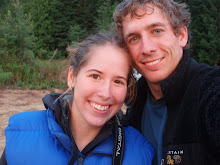
It certainly seems that Luke has been doing most of the blogging recently, which is mostly that I've been so ridiculously busy with school that I've barely had time to do anything except schoolwork and sleep.
But now, finally, I've reached the Holiday break (actually, I started it about a week ago, but was busy climbing in JTree with Luke and doing all the Christmas wrapping here at home). Home, however, is now Poulsbo, Washington (not far from Bainbridge Island or the Navy base in Bremerton, if you're familiar with the area). So even though I have free time, it's pretty much been raining outside the entire time I've been home, which makes it a little hard to do any climbing outside. Hopefully today I'll get my act together and go running in the rain.
Whatever I do, I'm pretty happy to have this opportunity to catch up on life - do some research into grad schools, which I'll probably be applying to next fall, go running, chill out with the doggies, read a book for fun (Wicked by Gregory Maguire)! Hopefully I can regain some of my motivation for climbing, too. School can tend to make me so stressed out in general, that even climbing becomes stressful. It's so frustrating! It's been really hard to balance everything and to really believe I'm giving everything what it deserves (school, climbing, frisbee, and Luke, in no particular order). I'm hoping that a new term at school and a new (very exciting) geology research project can help me get my crazy life under control. Next term will also mark the beginning of the Ultimate Frisbee tournament season, meaning that although several weekends will be dedicated to frisbee, our coach will resume running our practices, which takes a big load off myself and my co-captain.
For now, though, I'm just excited for our New Year's trip to Arizona - new climbing areas (BASALT!!! hopefully), a new state to visit, and hopefully some sweet crack climbing to kick me back into gear to prepare for Indian Creek in March. So many 5.11's and 5.12's to send!
For now, hope everyone's having a great holiday season (maybe enjoying some fresh powder?)!
Saturday, December 22, 2007


Friday, December 21, 2007
Happy Holidays
2007 has been an amazing year for climbing and this will most likely be my last post of the year. Moving to a new place has allowed me to climb more often and at a whole bunch of amazing areas. I look forward to 2008 and many months of exploration and climbing! I thought I would add some photos to for a bit of spice, hope you enjoy!
 Lizzy is already in Seattle for Christmas and I will be flying up there tomorrow. We will be in Seattle until the 28th visiting family and friends.
Climbing has been winding down recently as the temps have been a bit colder. Our only trip in the last three weeks was to Joshua Tree this past weekend. We had some really warm weather which was nice and unexpected! We did a bit of trad, sport, bouldering and multi-pitch. The mix of everything was nice and I even hopped on Iron Resolution (photo above/right) which was really cool despite the fact that it is way too hard! We also got to climb the Headstone at sunset which was fun(photo below). I had never lead before in my down jacket and it ended up being a good decision. It probably dropped 20 degrees in the hour and a half before sunset.
We are going to try to head to Arizona for a short New Years climbing trip. I will be posting up a trip report when we get back.
Thanks to everyone that reads our blog. It has been a great experience writing these blogs!
Lizzy is already in Seattle for Christmas and I will be flying up there tomorrow. We will be in Seattle until the 28th visiting family and friends.Climbing has been winding down recently as the temps have been a bit colder. Our only trip in the last three weeks was to Joshua Tree this past weekend. We had some really warm weather which was nice and unexpected! We did a bit of trad, sport, bouldering and multi-pitch. The mix of everything was nice and I even hopped on Iron Resolution (photo above/right) which was really cool despite the fact that it is way too hard! We also got to climb the Headstone at sunset which was fun(photo below). I had never lead before in my down jacket and it ended up being a good decision. It probably dropped 20 degrees in the hour and a half before sunset.
We are going to try to head to Arizona for a short New Years climbing trip. I will be posting up a trip report when we get back.
Thanks to everyone that reads our blog. It has been a great experience writing these blogs!

If anyone has questions or topics there are interested in let us know via comment or email. DreamInVertical at rockclimbing.com
Cheers!
- Luke
Monday, December 10, 2007
Climbing Shoes
So the recent news is that the V10’s are going to be discontinued by Five Ten. This super aggressive slipper is going to be replaced by the brand New Jet7. As far as I know RockCreek has exclusive distribution of the Jet7 until 2008 and they have a limited stock. I heard that Paul Robinson climbed in the Jet7 during the Triple Crown. Despite crushing at this comp he has created a petition to bring back the V10.
I think that people should not be worried about the V10 yet. It was almost 3 years from the first initial news of the cobra being replaced until La Sportiva stopped selling it. The same was true of the old Five Ten dragons. The new dragons are being worn by lots of super strong climbers proving that change can be a good thing. While a replacement slipper may not be in the works for this year perhaps Five Ten is going to bring a new slipper to market in late 2008. Hopefully I can do some research and find out. Edit: See the comments for more discussion on the V10.
The Climbing Narc had a post a while ago about shoes and how many shoes people have. I know most people only have a few pairs of shoes but I own or have worn out about 25 pairs of shoes or so. This has been a product of many years of climbing and a desire to experiment with different models of shoes. A large reason for the number of pairs of shoes is that I can usually get a new pair cheaper than I could get an old pair resoled. I think there is something amazing about a shoe right after it breaks in.
Over the last 5 years I have climbed between two and five days a week for the majority of the year. I would climb more in the summer and at least half of those days were in the gym. I like to savor my climbing shoes and I don’t usually mix between outdoor shoes and indoors shoes. Once a shoe became worn down it would get delegated to indoor duty. Thus I end up doing most of my climbing on plastic in blown out pairs of shoes
For the majority of my climbing I like a sensitive flat shoe that is tight to put on but becomes useable with a bit of warmth and sweat. I am currently on my 6th pair of cobras which were my favorite shoe for the longest time. They jam well, are easy to take off and are very sensitive. As well they smear really well; the biggest problem is they don’t make them any more and they don’t resole well. Because of this I rarely use my remaining pair of cobras. After these shoes stopped being produced I “discovered” the Muira after much prodding by my girlfriend. I now have 4 pairs of these shoes and use them for almost everything. They have an amazing heel cup and are a great all around shoe.
The one thing that both the Muria’s and the Cobra’s lack is a down-turned toe. This can be essential to small edging and steep boulder problems. I have one pair of Testarossa’s that I use exclusively for this type of climb. They are really tight and I only wear them when I am trying to send a project or I need to pull extra hard with my toes. The aggressive curve of the rand on the Testarossa’s is amazing and it gives a lot of power that the Muria’s lack. I really think that different shoes make a significant difference on certain climbs. It may just be the mindset that my feet can stick to anything, but I usually send harder wearing the Testarossa’s.
Each person will have a different preference for climbing shoes and the fit of your foot should be the biggest consideration. It is also important to make sure that the shoe is designed for what you plan on using it for. If you plan on steep heelhooking it might not be the best thing to buy a slipper. You don’t want your toes curled too much for crack climbing and velcro shoes can be problematic with jamming in hand cracks and larger. If you get a shoe that is too tight or down-turned it can be very difficult to smear.
This year I hope to get a pair of the Es Pontas and the new Anasazi 2.0. I wish that more US climbing shops would stock the Scarpa climbing shoes since they look very cool. I don’t know how they size their shoes and with the addition of Mad Rock and Evolv it is almost impossible to know what size climbing shoes you should buy.
That’s all for now,
Luke
I think that people should not be worried about the V10 yet. It was almost 3 years from the first initial news of the cobra being replaced until La Sportiva stopped selling it. The same was true of the old Five Ten dragons. The new dragons are being worn by lots of super strong climbers proving that change can be a good thing. While a replacement slipper may not be in the works for this year perhaps Five Ten is going to bring a new slipper to market in late 2008. Hopefully I can do some research and find out. Edit: See the comments for more discussion on the V10.
The Climbing Narc had a post a while ago about shoes and how many shoes people have. I know most people only have a few pairs of shoes but I own or have worn out about 25 pairs of shoes or so. This has been a product of many years of climbing and a desire to experiment with different models of shoes. A large reason for the number of pairs of shoes is that I can usually get a new pair cheaper than I could get an old pair resoled. I think there is something amazing about a shoe right after it breaks in.
Over the last 5 years I have climbed between two and five days a week for the majority of the year. I would climb more in the summer and at least half of those days were in the gym. I like to savor my climbing shoes and I don’t usually mix between outdoor shoes and indoors shoes. Once a shoe became worn down it would get delegated to indoor duty. Thus I end up doing most of my climbing on plastic in blown out pairs of shoes
For the majority of my climbing I like a sensitive flat shoe that is tight to put on but becomes useable with a bit of warmth and sweat. I am currently on my 6th pair of cobras which were my favorite shoe for the longest time. They jam well, are easy to take off and are very sensitive. As well they smear really well; the biggest problem is they don’t make them any more and they don’t resole well. Because of this I rarely use my remaining pair of cobras. After these shoes stopped being produced I “discovered” the Muira after much prodding by my girlfriend. I now have 4 pairs of these shoes and use them for almost everything. They have an amazing heel cup and are a great all around shoe.
The one thing that both the Muria’s and the Cobra’s lack is a down-turned toe. This can be essential to small edging and steep boulder problems. I have one pair of Testarossa’s that I use exclusively for this type of climb. They are really tight and I only wear them when I am trying to send a project or I need to pull extra hard with my toes. The aggressive curve of the rand on the Testarossa’s is amazing and it gives a lot of power that the Muria’s lack. I really think that different shoes make a significant difference on certain climbs. It may just be the mindset that my feet can stick to anything, but I usually send harder wearing the Testarossa’s.
Each person will have a different preference for climbing shoes and the fit of your foot should be the biggest consideration. It is also important to make sure that the shoe is designed for what you plan on using it for. If you plan on steep heelhooking it might not be the best thing to buy a slipper. You don’t want your toes curled too much for crack climbing and velcro shoes can be problematic with jamming in hand cracks and larger. If you get a shoe that is too tight or down-turned it can be very difficult to smear.
This year I hope to get a pair of the Es Pontas and the new Anasazi 2.0. I wish that more US climbing shops would stock the Scarpa climbing shoes since they look very cool. I don’t know how they size their shoes and with the addition of Mad Rock and Evolv it is almost impossible to know what size climbing shoes you should buy.
That’s all for now,
Luke
Friday, December 7, 2007
Projects and Goals
I dream about rock climbing all the time, the routes I want to do, the places I have been and the people I have climbed with. Climbing is so much more than an extreme sport or a test of physical prowess it really is a lifestyle. My climbing lifestyle is motivated by the places I read about and the routes that I want to go out and climb. I train, go to the gym and work on getting stronger so that I can climb all of these projects. To be able to travel the world and sample the best routes at a given area is my ultimate goal.
There are just so many places to climb in the world and so many stunning routes. From simple boulder problems at Bishop to the tall granite walls of Yosemite. Because I want to be able to climb them all the majority of my goals revolve around being a well rounded climber. My list of projects varies in both style of climbing and global location. While there is a clear focus on long hard traditional routes I also enjoy single pitch sport climbing and bouldering.
Motivation is very important for training and a key element in a day to day climbing routine. It can be hard to keep doing those sit ups every week or those hang board sessions when you don’t have some goal to shoot for. I find that medium term goals are very important so that I can stay excited about climbing. Even though a medium term goal may not be your dream route it will keep you positive about climbing. Going all out when training can be problematic since you have to make sure to pay attention to your body and avoid injury. If a climber sets there short or medium term goals too high it can be hard when you can not meet your expectations. It is much better to be honest and set a moderate goal before worrying about finding a really difficult project for a long term goal.
When attempting a new project it can be necessary to gain new skills and fitness in order to succeed. To determine where you need to focus your training energy it can help to break the climb down and compare it to your strengths and weaknesses. One of my project routes is Romantic Warrior 12b. This is an eight pitch route on the Southwest face of the Warlock in the Needles. It includes four hard pitches one 11d, two 12a and one 12b. While I might aspire to onsight this route it will most likely take me multiple visits so I will get a feeling of the climb before I send it. In order to train for this climb I know that I need to elevate my endurance so I can handle leading so many hard trad pitches. As well the 12b and 11d pitches involve tricky stemming and RP’s. This has motivated me to find other routes with similar characteristics of lower grades to provide a ramp up. These medium term routes will help me gauge my fitness and let me know when I am ready to go try to climb Romantic Warrior.
This fall Lizzy and I traveled out to the Red River Gorge for the Petzl Roc Trip. This was a very motivational trip for the both of us and we spent a lot of time doing specific training in preparation. Instead of doing a jumble of bouldering, trad climbing and sport climbing we focused on clipping bolts and training endurance. With all of the work we put in we were really excited for the trip and both climbed very well and pushed our limits. The trip was an excellent motivator and gave us a time line to train and get into the proper shape for hard sport climbing.
Projects and Goals are really important as we come into winter. This weekend looks like all rain and last weekend was a bust as well. The temps are dropping and climbing must be done inside to maintain fitness. Many people don’t enjoy the gym but if you can find a way to make it fun it will greatly help you ability get back on projects in the spring. Training hard all winter has helped many climbers push the grades much harder than if they had just stayed home.
If you have a big list of routes to do it can put a lot of pressure on you since there is so much to do. It is important to remember that there is a lot of time and that you do the best at climbs that you train for. At the Red I excelled on crimpers since that had been what I was training on. When I did a slopey route I had a lot of trouble since I had not been climbing on slopely holds. So take one goal at a time and maximize your skill level for the climb you are focusing on. Pressure while climbing will only distract you and keep you from pushing to the limit. Remember Climbing is FUN!!
Here is a list of climbs that I want to do in my lifetime. I would like to do most them in the next five years or so but its tricky to know where I will be. This list comes from reading climbing magazines, chatting to other climbers and reading guidebooks. Many climbs are area classics or are very aesthetically pleasing. Desire for many climbs has stemmed from a really nice photo of the climb. Enjoy!
- Luke
Squamish:
Freeway
Grand Wall
The Needles:
Romantic Warrior
Scirocco
Yosemite:
Steck - Salathe
Astroman
The Rostrum
NW face of Half Dome
Nose in a day
Free Rider
Toulumne Meadows:
Bachar – Yerian
Lucky Streaks
Red Rocks:
Cloud Tower
Original Route, Rainbow Wall
The Gift
Smith Rocks:
Astro Monkey
Chain Reaction
Heinous Cling
Joshua Tree:
Equinox
Indian Creek:
Ruby’s Café
Way Rambo
Red River Gorge:
Kaleidoscope
No Redemption
Table of Colors Direct
Rumney:
Technosurfing
Suburban
Australia:
Trojan
Birdman from Alcatraz
Mr. Joshua
The Totem Pole
There are just so many places to climb in the world and so many stunning routes. From simple boulder problems at Bishop to the tall granite walls of Yosemite. Because I want to be able to climb them all the majority of my goals revolve around being a well rounded climber. My list of projects varies in both style of climbing and global location. While there is a clear focus on long hard traditional routes I also enjoy single pitch sport climbing and bouldering.
Motivation is very important for training and a key element in a day to day climbing routine. It can be hard to keep doing those sit ups every week or those hang board sessions when you don’t have some goal to shoot for. I find that medium term goals are very important so that I can stay excited about climbing. Even though a medium term goal may not be your dream route it will keep you positive about climbing. Going all out when training can be problematic since you have to make sure to pay attention to your body and avoid injury. If a climber sets there short or medium term goals too high it can be hard when you can not meet your expectations. It is much better to be honest and set a moderate goal before worrying about finding a really difficult project for a long term goal.
When attempting a new project it can be necessary to gain new skills and fitness in order to succeed. To determine where you need to focus your training energy it can help to break the climb down and compare it to your strengths and weaknesses. One of my project routes is Romantic Warrior 12b. This is an eight pitch route on the Southwest face of the Warlock in the Needles. It includes four hard pitches one 11d, two 12a and one 12b. While I might aspire to onsight this route it will most likely take me multiple visits so I will get a feeling of the climb before I send it. In order to train for this climb I know that I need to elevate my endurance so I can handle leading so many hard trad pitches. As well the 12b and 11d pitches involve tricky stemming and RP’s. This has motivated me to find other routes with similar characteristics of lower grades to provide a ramp up. These medium term routes will help me gauge my fitness and let me know when I am ready to go try to climb Romantic Warrior.
This fall Lizzy and I traveled out to the Red River Gorge for the Petzl Roc Trip. This was a very motivational trip for the both of us and we spent a lot of time doing specific training in preparation. Instead of doing a jumble of bouldering, trad climbing and sport climbing we focused on clipping bolts and training endurance. With all of the work we put in we were really excited for the trip and both climbed very well and pushed our limits. The trip was an excellent motivator and gave us a time line to train and get into the proper shape for hard sport climbing.
Projects and Goals are really important as we come into winter. This weekend looks like all rain and last weekend was a bust as well. The temps are dropping and climbing must be done inside to maintain fitness. Many people don’t enjoy the gym but if you can find a way to make it fun it will greatly help you ability get back on projects in the spring. Training hard all winter has helped many climbers push the grades much harder than if they had just stayed home.
If you have a big list of routes to do it can put a lot of pressure on you since there is so much to do. It is important to remember that there is a lot of time and that you do the best at climbs that you train for. At the Red I excelled on crimpers since that had been what I was training on. When I did a slopey route I had a lot of trouble since I had not been climbing on slopely holds. So take one goal at a time and maximize your skill level for the climb you are focusing on. Pressure while climbing will only distract you and keep you from pushing to the limit. Remember Climbing is FUN!!
Here is a list of climbs that I want to do in my lifetime. I would like to do most them in the next five years or so but its tricky to know where I will be. This list comes from reading climbing magazines, chatting to other climbers and reading guidebooks. Many climbs are area classics or are very aesthetically pleasing. Desire for many climbs has stemmed from a really nice photo of the climb. Enjoy!
- Luke
Squamish:
Freeway
Grand Wall
The Needles:
Romantic Warrior
Scirocco
Yosemite:
Steck - Salathe
Astroman
The Rostrum
NW face of Half Dome
Nose in a day
Free Rider
Toulumne Meadows:
Bachar – Yerian
Lucky Streaks
Red Rocks:
Cloud Tower
Original Route, Rainbow Wall
The Gift
Smith Rocks:
Astro Monkey
Chain Reaction
Heinous Cling
Joshua Tree:
Equinox
Indian Creek:
Ruby’s Café
Way Rambo
Red River Gorge:
Kaleidoscope
No Redemption
Table of Colors Direct
Rumney:
Technosurfing
Suburban
Australia:
Trojan
Birdman from Alcatraz
Mr. Joshua
The Totem Pole
Thursday, November 29, 2007
Climbing Style – Effects of Traveling and Road Trips
Climbing well is more complex than just being strong and pulling down hard. Climbing is about being in touch with your body and understanding the style of movement required for a particular ascent. As climbers we travel for many reasons beyond the simple pursuit of cranking in new places. I enjoy the different scenery, rock texture and challenges provided by new areas. As well I am excited to climb local classics and learn a new style of movement. Traveling can allow a climber to increase their repertoire of moves as well as their fitness.
All over the world there are destination climbing areas and each has a bit of specialized style that allows a climber to excel in that area. Some skills are more easily translated between areas but others must be learned. Many people try to split climbing into three simple categories of bouldering, trad and sport each having a different style of movement. I think there are more subtle attributes to climbing than these divisions. The way a climber moves on routes at the red river gorge is very different than how they would at maple canyon, even though both are sport climbing areas. It comes down to the fact that steep cobbles provide an alternate challenge to pockets and sloping rails. Each of these styles requires different strengths and will teach climbers a specific skill.
While most areas provide a variety of hold types there are some where locals have clear advantage. Areas such as Horsepens have a very distinct style and can be very tricky for the traveling climber. Slopers the size and grain of horsepens are rare and require subtle movement and squeezing that has to be learned in order to send the local test pieces. Being able to spend many days figuring out the intricate of southern slopers will allow a climber to push themselves harder.
I have never been a true local at any climbing area. I have been a weekend warrior and sent all of my hardest climbs on road trips. Near the end of a stay at a climbing area I would have tailored my skills to fit the demands of the given rock type. Learning how to pull on the holds or how to keep the pump at bay would allow me to take the next step. Beyond just adapting to the style of the rock an extended trip would allow my body to flow better over rock. Constantly climbing for even a few days can give a climber a better awareness of how to pull and move their body.
The problem is that mentally it can be hard to climb at your limit if you keep mixing up the style you climb in. Bouldering one weekend on granite the next on sandstone and then sport climbing on limestone can put a person out of touch with how to move. A climber needs to balance variety so that they can still benefit from different challenges. It can be really annoying to switch rock types when you have finally dialed your footwork in one style. I think the key is to take something from each experience and try to apply it to the next; sometimes it will work even though other times it will be a step backwards.
When I started leading I was a sport climber and to this day I probably still am. I started trad leading a year or so later and it made convinced me that the Yosemite Decimal System could not relate bolted climbs to those where you had to place cams and nuts. There was no way I should get spanked so badly by a 5.9 crack when I could clip up 5.11.
Trad climbing came to me slowly and I started going through the grades. As I placed more gear and cam sizes became obvious I realized that it wasn’t trad climbing it self that could be more difficult but rather the type of routes that one would place gear on. Certain rock types and climbing areas lend them selves to particular types of routes. It wasn’t the gear placement that made the trad climb harder as much as the expectations of the route and the style of movement.
This past weekend, climbing out in Red Rocks, I found my self in a new situation. The end of the day yielded an onsight of both an 11a crack and an 11a face route but which had been more difficult? In recent times I have been trying to remove doubt I have had about falling while trad climbing. While I have not taken more than an eight foot fall on a cam I have been able to push my self to trust the gear more than when I first started. While I had to place gear on the crack I did this weekend I found the climb slightly easier than the face route. The jamming was slightly insecure but the line and sequence was more obvious and faster to decipher. For once it seemed that with the right mindset I could keep pushing into the next level for trad climbing.
With trad climbing and sport climbing, granite and sandstone, it is important to keep an open mind and keep learning. Don’t take bolts for granted and don’t forget how to place cams. Take each jamming experience and relate it to your latest crimpy test piece. While I believe that it may be beneficial to specialize in a style of climbing there is much more to gain from being an all around climber. It allows one to travel all over the world and climb classic routes without having to worry about bolts or hold types. Whatever way you take it go on a road trip and test your self in a new area!
- Luke
All over the world there are destination climbing areas and each has a bit of specialized style that allows a climber to excel in that area. Some skills are more easily translated between areas but others must be learned. Many people try to split climbing into three simple categories of bouldering, trad and sport each having a different style of movement. I think there are more subtle attributes to climbing than these divisions. The way a climber moves on routes at the red river gorge is very different than how they would at maple canyon, even though both are sport climbing areas. It comes down to the fact that steep cobbles provide an alternate challenge to pockets and sloping rails. Each of these styles requires different strengths and will teach climbers a specific skill.
While most areas provide a variety of hold types there are some where locals have clear advantage. Areas such as Horsepens have a very distinct style and can be very tricky for the traveling climber. Slopers the size and grain of horsepens are rare and require subtle movement and squeezing that has to be learned in order to send the local test pieces. Being able to spend many days figuring out the intricate of southern slopers will allow a climber to push themselves harder.
I have never been a true local at any climbing area. I have been a weekend warrior and sent all of my hardest climbs on road trips. Near the end of a stay at a climbing area I would have tailored my skills to fit the demands of the given rock type. Learning how to pull on the holds or how to keep the pump at bay would allow me to take the next step. Beyond just adapting to the style of the rock an extended trip would allow my body to flow better over rock. Constantly climbing for even a few days can give a climber a better awareness of how to pull and move their body.
The problem is that mentally it can be hard to climb at your limit if you keep mixing up the style you climb in. Bouldering one weekend on granite the next on sandstone and then sport climbing on limestone can put a person out of touch with how to move. A climber needs to balance variety so that they can still benefit from different challenges. It can be really annoying to switch rock types when you have finally dialed your footwork in one style. I think the key is to take something from each experience and try to apply it to the next; sometimes it will work even though other times it will be a step backwards.
When I started leading I was a sport climber and to this day I probably still am. I started trad leading a year or so later and it made convinced me that the Yosemite Decimal System could not relate bolted climbs to those where you had to place cams and nuts. There was no way I should get spanked so badly by a 5.9 crack when I could clip up 5.11.
Trad climbing came to me slowly and I started going through the grades. As I placed more gear and cam sizes became obvious I realized that it wasn’t trad climbing it self that could be more difficult but rather the type of routes that one would place gear on. Certain rock types and climbing areas lend them selves to particular types of routes. It wasn’t the gear placement that made the trad climb harder as much as the expectations of the route and the style of movement.
This past weekend, climbing out in Red Rocks, I found my self in a new situation. The end of the day yielded an onsight of both an 11a crack and an 11a face route but which had been more difficult? In recent times I have been trying to remove doubt I have had about falling while trad climbing. While I have not taken more than an eight foot fall on a cam I have been able to push my self to trust the gear more than when I first started. While I had to place gear on the crack I did this weekend I found the climb slightly easier than the face route. The jamming was slightly insecure but the line and sequence was more obvious and faster to decipher. For once it seemed that with the right mindset I could keep pushing into the next level for trad climbing.
With trad climbing and sport climbing, granite and sandstone, it is important to keep an open mind and keep learning. Don’t take bolts for granted and don’t forget how to place cams. Take each jamming experience and relate it to your latest crimpy test piece. While I believe that it may be beneficial to specialize in a style of climbing there is much more to gain from being an all around climber. It allows one to travel all over the world and climb classic routes without having to worry about bolts or hold types. Whatever way you take it go on a road trip and test your self in a new area!
- Luke
Tuesday, November 20, 2007
Hesitation and Commitment
'I must not fear. Fear is the mind-killer. Fear is the little death that brings total obliteration. I will face my fear. I will permit it to pass over me and through me. And when it has gone past I will turn the inner eye to see its path. Where the fear has gone there will be nothing. Only I will remain.'
- Bene Gesserit "Litany Against Fear" from Dune by Frank Herbert
A climber’s mental attitude has everything to do with how he or she is going to perform on a climb. While hesitation and commitment can be lumped in with motivation I want to explore these mental elements as they effect the moment. The thoughts that are rushing through your head as you climb above your last piece or try to top out a boulder problem are very insightful. How can a climber improve their mental game so that the negative self talk can be reduced or eliminated?
When climbing a route or problem I think that climbers exert varied amounts effort throughout the duration. While the amount of physical exertion may be easy to gage the amount of mental effort can be harder to comprehend. Some times on a climb it can be very important to keep the right mindset even when the difficulty eases. A climb may be runout, have serious fall potential or a bad landing where hesitation could cause an unsafe fall. Keeping focus all the way to the top will help to insure success.
Comprehension about the gravity of a situation can have large consequences on the ability for a person to perform the needed actions. Many times a climber can deal with runouts and dangerous situations because they are not fully aware of the potential consequences. A climber can be unnerved when their belayer warns of ground fall danger or other possible problems that the climber thought they had under control. This mental insecurity can easily translate into a bigger problem if the climber starts over gripping or making bad decisions.
There are different mindsets that I think can be very helpful when climbing in order to be more successful. Pressure to send a route can be problematic when it causes a climber to be tentative or worrisome. Being able to be in the moment and distance ones self from expectation and pressure can be quite helpful. Many climbers do not recall the details from hard sends because they were fully engaged in the moment.
Being in the zone does not solve everything; being able to have control over your emotions can be as powerful if not more so than the zone. A problem with climbing in the zone can come when you snap out of it when the climbing becomes more difficult than expected and you are not properly prepared. Willingness to commit to difficult movement can be necessary and mental toughness is necessary. A mind set that allows commitment without taking difficulty for granted is very powerful.
Expectations of a route can have varied effects on a climber. Some climbers are easily intimidated by cruxy routes while others fail to maintain mental energy through sustained climbs. Knowing where a crux is on a route should give the climber an advantage because it allows them to mentally prepare for the complex or difficult sequence. A climber can make sure that they are rested and willing to give 100% to the next section of rock. We as climbers must strive to conquer our fears and hesitation and give a genuine effort.
As the act of climbing becomes more challenging I find my self more engaged in the movement. Clipping bolts and placing gear become integrated into the climbing motion and I am not overly worried about fall potential. Many times when I fail to assume the right mind set or am worried about falling I will dwell on the gear or bolts. The action of clipping a bolt does not help a climber recover lost energy but it often helps bolster a climber’s confidence. Many times I will feel much better after placing a cam even though the difficult of the climbing has not eased.
Looking at how climbing changes our mental state will ultimate lead to both a better understanding of ourselves and a break through in our climbing. Climbing highballs out at bishop this past weekend really made me think about how mental climbing really is. I would be perfectly able to do all of the moves on a climb but my body would not allow me to continue when I would climb far off the ground. Conquering this fear would open a new realm of climbing and it will be interesting to see how I can deal with fear in the future.
- Luke
Wednesday, November 7, 2007
Levitation 29 part 2 - Dealing With Fear.
Climbing routes recently has been a mental push for me. I don’t know if it has to do with a low level of motivation or just being disconnected from the zone. I have been feeling a larger than normal amount of uncertainty with my climbing. Perhaps it has been all of the sport climbing and the disconnect from the do not fall mentality. Maybe climbing at my limit more often has given me more doubt. I don’t exactly know the cause but I hope to fight through it and figure out how to climb more confidently.
Doubting my ability comes into play when I climb because I am in the middle of a burn and I struggle to keep climbing, since I don’t feel I can do it. It has been a bit frustrating to have all of this doubt when there is no obvious cause. There seem to be a few different mind sets that I encounter when I am climbing. They range from a relaxing send, free from doubt, to a fearful onsight where I struggle to commit to every move. I think what is happening to me is that I am hesitating and unable to commit because I am afraid of failure. I am tied to the success related to sending the route and unable to fully commit my self because of fear.
My hardest trad onsight to date came on a tricky finger crack in Squamish called Crime of the Century. It was much harder than anything I had tried to onsight before. The lack of precedence allowed me to give everything. Even though it was very difficult I was less worried about failing to onsight the climb. This disconnect from having to send allowed me to be less hesitant and through a lot of grunting and hard work I got to the top.
This all relates to Levitation 29 because it is a route that has been in my mind for over a year now. The goal was to onsight the route and when the time came to go out and try the route this weekend there was a lot of intimidation. I was afraid that I would not be strong enough; I would be too tired after the long approach or that I would just fall/fail.
I had recently been training on longer sport routes but nothing would compare to a nine pitch route. Almost half of the pitches were 11a or harder and I would be leading all the hard pitches. While the crux fifth pitch would stand out as the technical crux of the route I would have to make sure to keep it together to the top.
The first hard pitch was the 2nd which I linked to the first. The climbing was fun and complex to a difficult crux. It seems height dependant as there are good holds but they were too far away for me to reach. This lead to some easier pitches which I followed and then the 5th pitch. The plan had been to skip bolts and link this to the next pitch for 150 feet of fun. As I started climbing up the climbing was harder than expected and I knew I would have to climb the pitches separately.
The crux of the 5th pitch started from a good 2 foot long hand jam sized pod. It moved from there up a few moves of laybacking into a fist pod with some bad face holds inside and a decent left hand crimp. You had good feet for the clip but had to move up to smears for the next move. This move, my crux, was a reach from either a bad fist jam(for my hands) or from the small but positive left crimp. I watched my right fist sliding out of the jam as I stabbed for the next finger lock. I got it and moved up to the next clip but I was physically and mentally fried.
I had spent so much time trying to find a better sequence through the crux that I was now really tired. The pitch did not ease up for many more clips so I really had to fight for the onsight. I wanted to send this route so bad and I knew that I could do it. This quote from this Steph Davis Blog was in the back of my mind as I kept refusing to let go.
“I’ve done all my groundwork. I am totally capable of doing this, and I know it for a fact, because I trained, practiced, meditated, and I am absolutely prepared to pull this off.”
I still climbed slowly and hesitantly through the pitch but I managed to make it to the anchors without falling. The next pitches were less difficult but I was still quite tired. I wonder if climbing the crux pitch faster would have been successful and saved me energy. I am still trying to figure out the best strategy for climbing onsight. I have to learn to work through my trust issues and climb with more certainty.
This climb was an amazing experience and I would be excited to go back and do it again. It pushed me both physically and mentally and I am still reflecting on the experience and learning lessons.
- Luke
Doubting my ability comes into play when I climb because I am in the middle of a burn and I struggle to keep climbing, since I don’t feel I can do it. It has been a bit frustrating to have all of this doubt when there is no obvious cause. There seem to be a few different mind sets that I encounter when I am climbing. They range from a relaxing send, free from doubt, to a fearful onsight where I struggle to commit to every move. I think what is happening to me is that I am hesitating and unable to commit because I am afraid of failure. I am tied to the success related to sending the route and unable to fully commit my self because of fear.
My hardest trad onsight to date came on a tricky finger crack in Squamish called Crime of the Century. It was much harder than anything I had tried to onsight before. The lack of precedence allowed me to give everything. Even though it was very difficult I was less worried about failing to onsight the climb. This disconnect from having to send allowed me to be less hesitant and through a lot of grunting and hard work I got to the top.
This all relates to Levitation 29 because it is a route that has been in my mind for over a year now. The goal was to onsight the route and when the time came to go out and try the route this weekend there was a lot of intimidation. I was afraid that I would not be strong enough; I would be too tired after the long approach or that I would just fall/fail.
I had recently been training on longer sport routes but nothing would compare to a nine pitch route. Almost half of the pitches were 11a or harder and I would be leading all the hard pitches. While the crux fifth pitch would stand out as the technical crux of the route I would have to make sure to keep it together to the top.
The first hard pitch was the 2nd which I linked to the first. The climbing was fun and complex to a difficult crux. It seems height dependant as there are good holds but they were too far away for me to reach. This lead to some easier pitches which I followed and then the 5th pitch. The plan had been to skip bolts and link this to the next pitch for 150 feet of fun. As I started climbing up the climbing was harder than expected and I knew I would have to climb the pitches separately.
The crux of the 5th pitch started from a good 2 foot long hand jam sized pod. It moved from there up a few moves of laybacking into a fist pod with some bad face holds inside and a decent left hand crimp. You had good feet for the clip but had to move up to smears for the next move. This move, my crux, was a reach from either a bad fist jam(for my hands) or from the small but positive left crimp. I watched my right fist sliding out of the jam as I stabbed for the next finger lock. I got it and moved up to the next clip but I was physically and mentally fried.
I had spent so much time trying to find a better sequence through the crux that I was now really tired. The pitch did not ease up for many more clips so I really had to fight for the onsight. I wanted to send this route so bad and I knew that I could do it. This quote from this Steph Davis Blog was in the back of my mind as I kept refusing to let go.
“I’ve done all my groundwork. I am totally capable of doing this, and I know it for a fact, because I trained, practiced, meditated, and I am absolutely prepared to pull this off.”
I still climbed slowly and hesitantly through the pitch but I managed to make it to the anchors without falling. The next pitches were less difficult but I was still quite tired. I wonder if climbing the crux pitch faster would have been successful and saved me energy. I am still trying to figure out the best strategy for climbing onsight. I have to learn to work through my trust issues and climb with more certainty.
This climb was an amazing experience and I would be excited to go back and do it again. It pushed me both physically and mentally and I am still reflecting on the experience and learning lessons.
- Luke
Subscribe to:
Posts (Atom)